🍋 100% Plant-Based Lemon Custard
A dense, velvety lemon custard with no eggs or dairy: just plant milk, cornstarch, sugar and fresh lemon juice. Vegan, gluten-free, 20 min active.
100% Plant-Based Lemon Custard
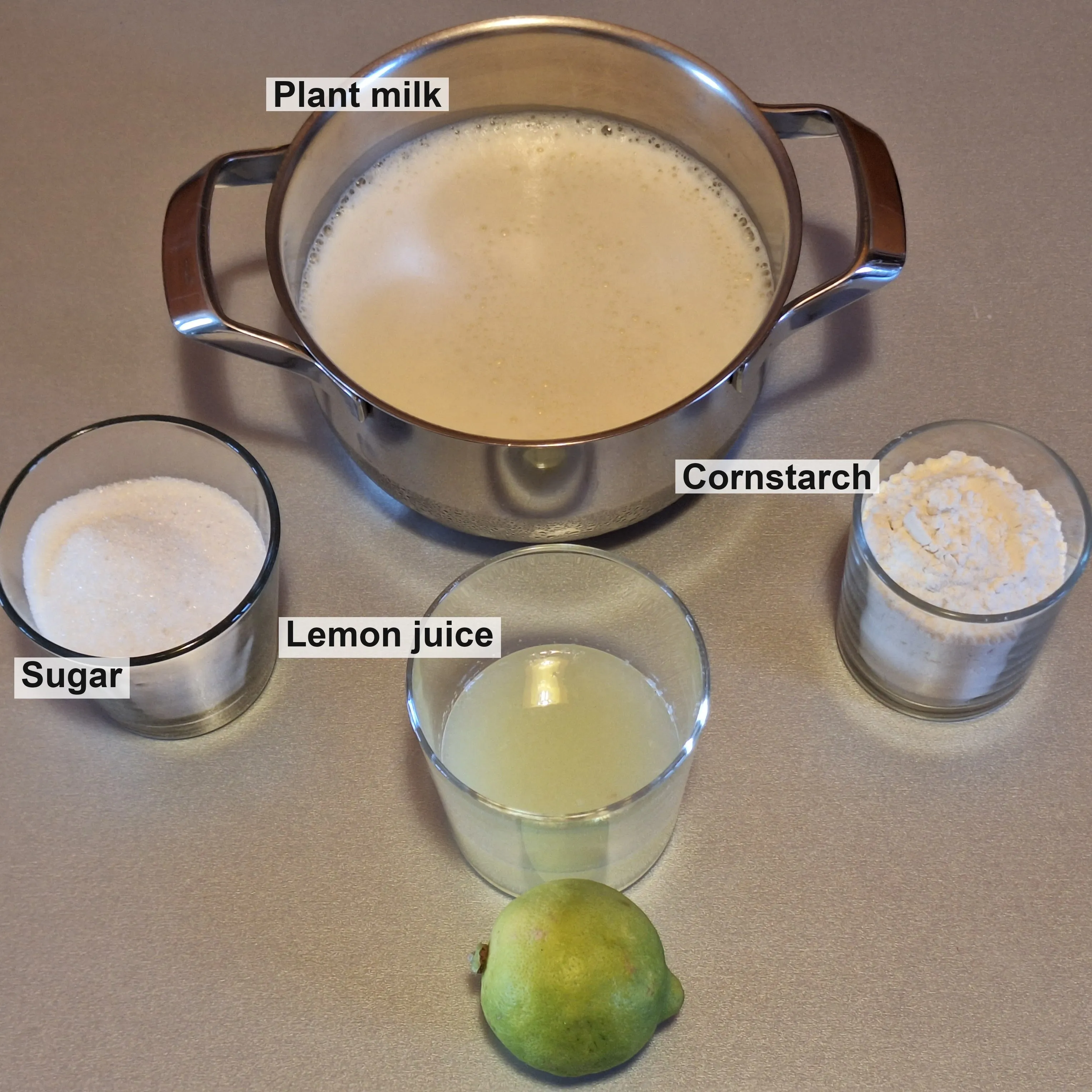
1. Ingredients
| Ingredient | Quantity |
|---|---|
| Plant milk (soy or oat) | 500 g |
| Sugar | 100 g |
| Cornstarch | 60 g |
| Fresh lemon juice | 80 g |
| Ground turmeric (optional) | 5 g |
| Lemon zest (optional) | 1 lemon |
2. Method
- In a large saucepan, dry-mix the 60 g cornstarch with the 100 g sugar. This coats the starch granules and prevents lumps once the liquid is added.
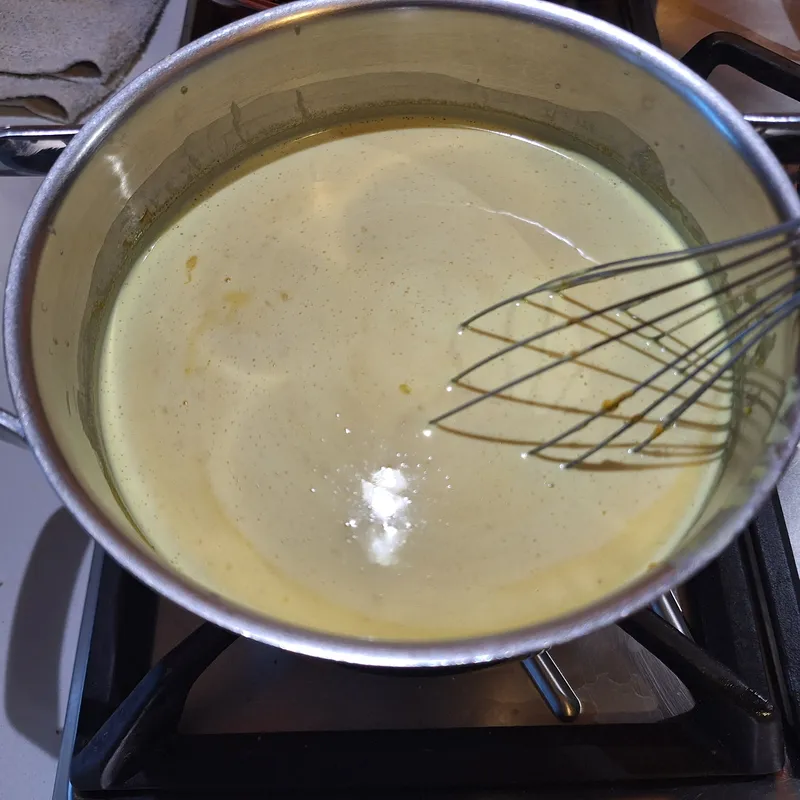
- Slowly pour in the cold 500 g plant milk, whisking by hand until the mixture is perfectly smooth. If using the 5 g turmeric, add it now and whisk until evenly distributed. Optional: if you want to use lemon zest, add it now. I have made this custard with and without zest and notice no particular difference in the final result; personally I skip it, to avoid the nuisance of removing the zest once the custard thickens.
- Set the pan over medium heat and whisk constantly, without stopping. For the first few minutes the mixture stays liquid; around 65-75 °C it starts to thicken progressively.
- Watch the surface: bubbles and foam form in the early stages. When the bubbles vanish and the custard turns visibly denser and glossy, add the 80 g lemon juice all at once and whisk vigorously to incorporate it.
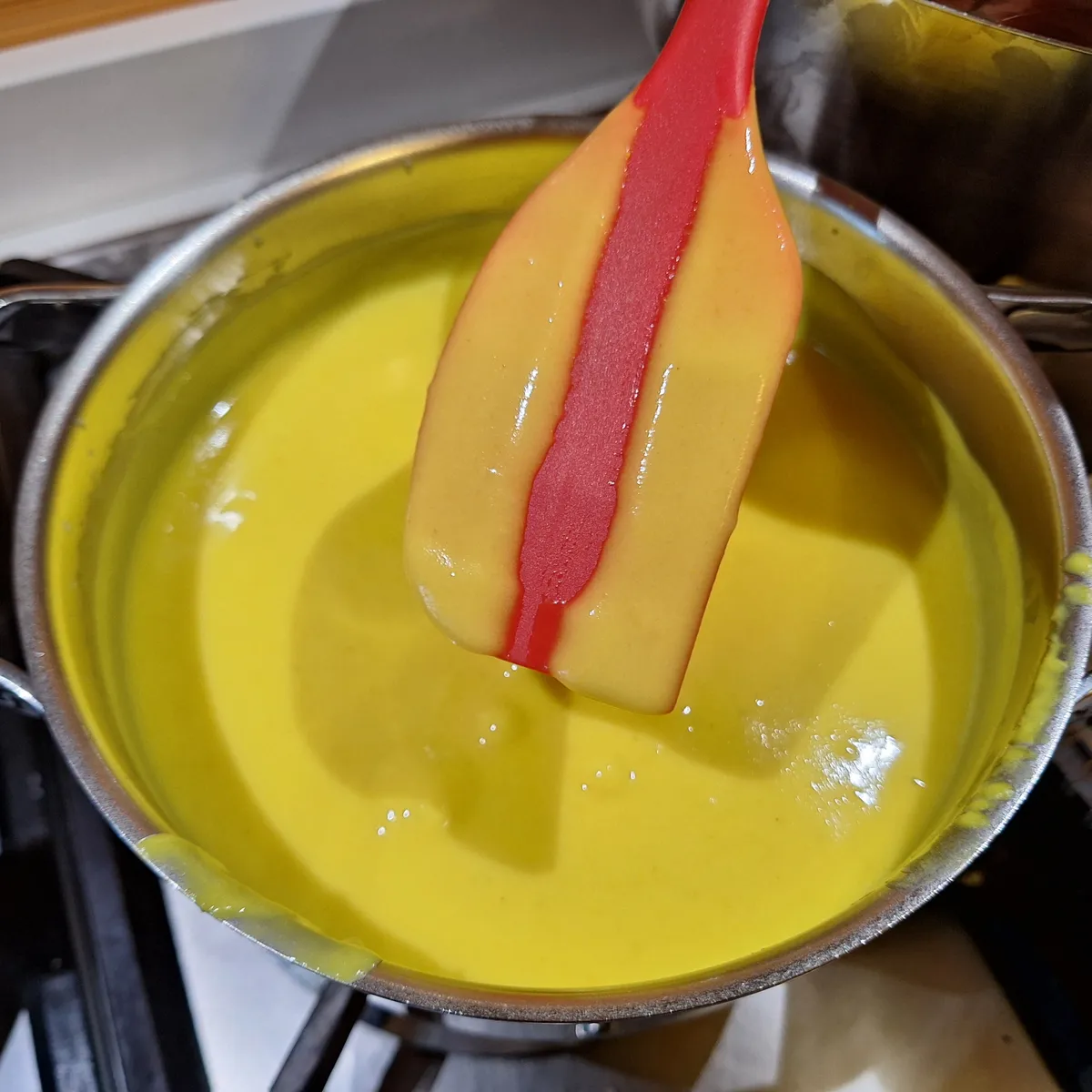
- Keep cooking until the custard is visibly thick and smooth: you can tell because it resists the spatula or spoon you are stirring with. This completes starch gelatinisation and removes the raw-starch taste. Do not cook further, and take the pan off the heat. Keep stirring for 1 minute.
- Transfer the custard to a glass or ceramic container. To prevent a skin from forming, you can dust a little sugar over the surface, or cover with a lid suitable for contact with hot food. Cling film, plastic and foil in general are not suitable. If instead you plan to blend the custard before use, you can leave the surface uncovered (cover with a lid not in contact).
- Let it cool at room temperature for 15-20 minutes, then refrigerate for at least 2 hours. The custard thickens further as it cools; if it sets too firm, whisk briefly to bring it back to the desired texture. If you are making this custard for a fruit tiramisù, 15-20 minutes is enough, after which you can layer the custard into the tiramisù.
3. Technical Notes
Lemon pastry cream or lemon curd?
These are two preparations with a different thickening mechanism, not simply "more or less starch". Classic lemon curd contains no starch: it thickens with eggs and butter, gently coagulated at around 75-80 °C, and the dominant liquid is lemon juice (with butter and eggs in significant amounts). Lemon pastry cream, by contrast, has milk as the dominant liquid and thickens with starch, typically around 7-8% of the milk's weight, plus yolks that add structure.
Our recipe belongs to this second family, but in a 100% plant-based version: with no yolks, all the thickening falls to the starch, and on top of that lemon acid reduces starch's thickening power (which is why lemon custards need more starch than plain ones). That is why 60 g of starch per 500 g milk (12%) is correct here and not a mistake: it replaces the structure that yolks would give in the classic version. The result is a dense, almost pudding-like custard — intentionally so. Adding more starch would make it rubbery; for a looser custard, reduce the starch to 45-50 g.
| Feature | Lemon curd (English) | Lemon pastry cream (this recipe) |
|---|---|---|
| Dominant liquid | Lemon juice | Milk (plant-based) |
| Thickener | Eggs + butter (coagulation) | Cornstarch (gelatinisation) |
| Starch | None | 60 g (about 12% of the milk) |
| Flavour | Sharp, intense, citrusy | Tangy but pleasant, balanced by the sweetness |
| Texture | Dense, spreadable, rich | Dense cream, between a classic custard and a pudding |
To see the difference in numbers — not as a recipe to follow, but as an order of magnitude of the ratios — this table compares typical reference values (normalised for about 400 ml of product):
| Per ~400 ml | Lemon curd | Lemon pastry cream |
|---|---|---|
| Liquid | Lemon juice: the main part | Milk: the main part, lemon juice a small share |
| Starch | 0% (none) | about 7-9% of the milk's weight |
| Eggs | Whole eggs + yolks (main thickener) | Yolks, as structure on top of the starch |
| Fat | Butter (significant part) | Little or none (none in the plant-based version) |
Choosing the plant milk
Not all milks behave the same way when cooked. The table compares the most common ones, including cow's milk as a reference. For this custard, soy milk is the best choice and oat an excellent alternative; cow's milk technically works and gives body, but its proteins (casein) can curdle on contact with lemon acid, so as a final result it is not better than soy.
| Milk | Protein (g/100 ml) | Cooking performance | Verdict |
|---|---|---|---|
| Soy | 3.3-3.8 | Thickens well, stable with acids | Best |
| Oat | 0.5-1.0 | Creamy from beta-glucans, neutral taste | Excellent alternative |
| Whole cow's | 3.3 | Good body, but casein can curdle with lemon | Works, similar to soy |
| Almond | 0.4-1.0 | Lighter, less full-bodied custard | Acceptable |
| Rice | 0.1-0.3 | Too watery and sweet, sticky texture | Not recommended |
How to tell the custard is ready
The most reliable way is the resistance on the spatula (see method). If you want to understand what happens temperature-wise, this table summarises the cornstarch phases during cooking.
| Temperature | What happens | What you see |
|---|---|---|
| 20-55 °C | Starch is suspended, not yet active | Liquid mixture, no change |
| 55-65 °C | Granules start to swell (gelatinisation begins) | Slight increase in thickness |
| 65-80 °C | Gelatinisation underway, amylose released | Rapid thickening, opaque custard, bubbles vanish |
| 80-95 °C | Full gelatinisation, peak viscosity | Dense, glossy custard, resists the spatula |
| above 95 °C prolonged | Starch degradation | Custard thins out again (often irreversible) |
4. Variants
- Vanilla custard: omit the lemon juice and flavour with vanilla extract or a vanilla pod.
- Orange custard: use orange juice and zest instead of lemon; the result is sweeter and more delicate.
- Chocolate custard: melt chocolate or cocoa into the hot custard at the end of cooking.
- Coffee custard: flavour with espresso or instant coffee.
- Blueberry custard: stir in blueberry purée, adjusting the sugar to their sweetness.
5. Storage
After cooking, if you want to cool it quickly you can rest the base of the pan in cold water and stir for a few minutes before storing.
- Room temperature: 2 hours maximum. Although egg- and dairy-free, it is a moist food rich in sugars and starches, so it favours bacterial growth: beyond 2 hours it is best moved to the fridge.
- Refrigerator: up to 4 days, in an airtight container, better still with the surface in contact with a food-safe material. The custard firms up a lot due to starch retrogradation: if it sets too hard, whisk it or blend with a stick blender, adding a splash of plant milk if needed.
- Freezer: up to 2 months, but you lose the original texture: it turns grainy. Better to freeze it in portions, thaw in the fridge and blend to re-emulsify. Alternatively, use the thawed custard in preparations that are cooked afterwards (tarts, cakes).
6. References
- Serious Eats — Lemon Pastry Cream: seriouseats.com/lemon-pastry-cream
- King Arthur Baking — Lemon Curd: kingarthurbaking.com/recipes/lemon-curd-recipe
- Baking Sense — Vanilla Pastry Cream: baking-sense.com/2018/01/31/pastry-cream
- David Lebovitz — Lemon Curd: davidlebovitz.com/improved-lemon-curd
- LibreTexts — Chemistry of Cooking, Thickening Agents (starch gelatinisation): chem.libretexts.org