☁️ Greek Yogurt Cloud Cake
Greek yogurt cloud cake: fluffy, light and airy. No cream cheese version with quantities for both 20 cm and 28 cm tins.
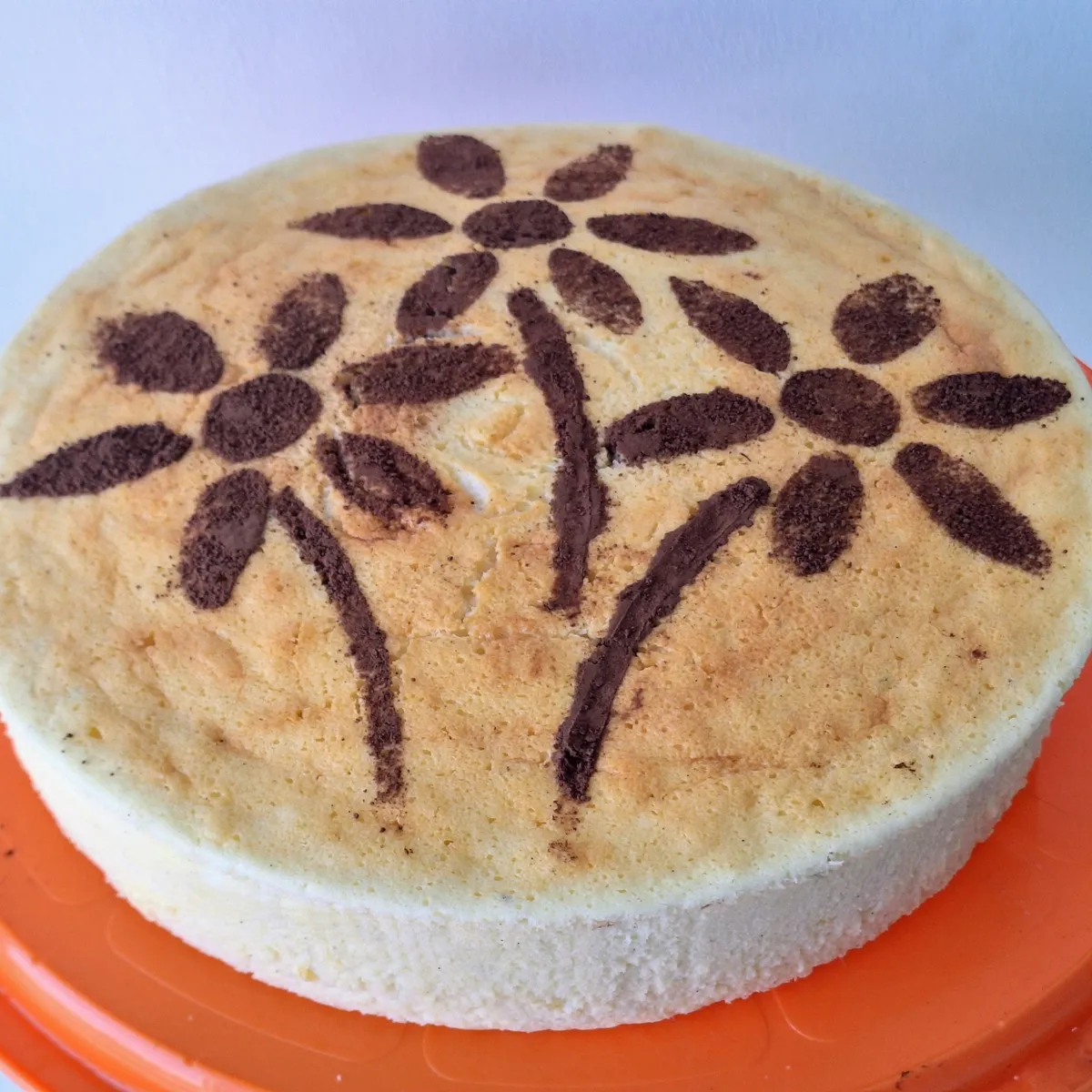
Greek Yogurt Cloud Cake
Several people asked me for a slightly lighter version, just as good, of the Philadelphia cloud cake. I created this Greek yogurt version, already tested and I can confirm it's worth it; it's delicious and still has that cloud effect.
1. Ingredients
| Ingredient | 20 cm tin | 28 cm tin (×1.5) |
|---|---|---|
| Full-fat Greek yogurt (5% fat) | 240 g | 360 g |
| Seed oil (sunflower, corn or rice) | 48 g | 72 g |
| Whole milk | 72 ml | 108 ml |
| Egg yolks | 6 (~108 g) | 9 (~162 g) |
| Weak plain flour (type 0, W < 170) | 48 g | 72 g |
| Cornstarch or potato starch | 18 g | 27 g |
| Grated lemon zest | ½ lemon | 1 lemon |
| Lemon juice (in the base) | 12 ml | 18 ml |
| Vanilla extract | 6 g | 9 g |
| Egg whites | 6 (~180 g) | 9 (~270 g) |
| Caster sugar | 84 g | 126 g |
| Lemon juice (in the meringue) | 5 ml | 7 ml |
| Honey (optional) | 14 g | 21 g |
2. Method
Note: the quantities listed below refer to the 20 cm tin. For the 28 cm tin, see the ingredients table (×1.5 column).
- Oven and tin: preheat to 160°C static (never fan) with the water bath tray already inside. Line the tin with baking paper, letting it extend 3 cm above the rim.
- Yogurt base: in a large bowl, combine 240 g Greek yogurt, 48 g seed oil and 72 ml milk. Whisk until smooth and homogeneous. Add the 6 egg yolks one at a time, mixing well after each. Sift 48 g flour and 18 g starch directly into the mixture; whisk until smooth. Strain through a fine-mesh sieve to remove any lumps. Add zest of ½ lemon, 12 ml lemon juice and 6 g vanilla extract.
- Meringue: in a clean, dry steel or glass bowl (not plastic), pour the egg whites at room temperature. Add 5 ml lemon juice and start whisking on low speed for 1 minute. Increase to medium speed and continue until the volume has quadrupled (~4 minutes).
Only at this point add 84 g sugar in 3 additions, continuing to whisk at medium-high speed.
After the second addition, pour in 14 g honey. Continue until soft-medium peaks form: the meringue folds gently at the tip. The sugar must be completely dissolved. Do not whisk to stiff peaks. - Fold (in 3 additions): pour ⅓ of the meringue into the yogurt base; mix vigorously with a whisk to lighten. Add the second ⅓ and fold gently with a wide spatula (bottom-to-top motions). Pour the base into the bowl with the final ⅓ of meringue; fold with broad strokes until white streaks disappear. Do not over-mix.
- Pour into the tin: transfer the batter into the lined tin. Tap the tin on the counter 2-3 times to release large air bubbles. Run a skewer in a zig-zag across the surface.
- Water bath baking (2-temperature method): place the tin in the tray already in the oven. Pour water preheated to ~50°C into the outer tray (1-1.5 litres for 20 cm; 2 litres for 28 cm), up to 2 cm deep.
Phase 1: 160°C for 25 minutes (the cake rises and browns on top).
Phase 2: reduce to 140°C for 45-50 minutes (cooks the interior gently without further expansion).
The cake is done when: golden on top, barely wobbles in the centre when gently shaken, edges pull slightly away from the tin. - Gradual cooling (important step): turn off the oven. Open the door about 5 cm (prop with an oven glove). Leave the cake in the oven for 45 minutes (longer than the cream cheese version; the structure is more delicate). Remove from the water bath. Cool completely on a wire rack (1-2 hours). Refrigerate for at least 4-6 hours (overnight is better) before serving.
3. Baking for 28 cm tin
| Phase | Temperature | Duration | Notes |
|---|---|---|---|
| Phase 1 | 160°C | 20-22 min | Larger surface browns faster |
| Phase 2 | 140°C | 40-45 min | Centre closer to the surface; cooks sooner |
| Cooling | Oven off, door ajar 5 cm | 45 min | Unchanged; delicate structure needs patience |
You need an outer tray at least 32-34 cm wide. Preheat ~2 litres of water to 50°C.
4. Storage
- Refrigerator: 3-4 days in an airtight container. The flavour improves after 12-24 hours.
- Room temperature: keeps well for one day. After 24 hours the fridge is preferable (the texture holds better cold).
- Freezing: yes, up to 2-3 months. Wrap tightly in cling film (no air) then in an airtight container. Thaw in the fridge (never at room temperature). The texture loses a tiny bit of airiness (ice crystals break some microbubbles), but the difference is barely noticeable. For single slices: freeze separately for convenience.
5. Differences from the cream cheese version
| Aspect | With cream cheese | With Greek yogurt + oil |
|---|---|---|
| Flavour | Delicate, creamy, neutral | Fresh and light, with a lively yogurt note |
| Texture | Classic cotton cheesecake | Closer to soufflé/chiffon |
| Heaviness | Medium-light | Very light |
| Stability | Good | Fair (requires more careful technique) |
| Calories (slice ~80 g) | ~180 kcal | ~120 kcal |
| Deflation risk | Medium | Medium-high (manageable with 45 min cooling) |
| Softness when cold | Slightly firm | Very soft (oil stays liquid) |
If it's your first time, the Philadelphia/cream cheese version forgives a few mistakes, while the yogurt version requires a bit more precision. That said, the first time I made the yogurt version anyway, I made a few too many mistakes, it sank a little, it wasn't very tall, but it was still delicious and was devoured by adults and children alike.
6. Technical Notes
For the control freaks: below you'll find tables on meringue whipping times, the cream of tartar/lemon substitution, and the difference between cornstarch and potato starch.
Indicative times using a stand mixer or electric whisk in a bowl (metal/glass, no plastic).
| Stage | Speed | Time | What you see |
|---|---|---|---|
| Foam | Low (speed 2-4) | 1-2 min | Large bubbles, still transparent |
| Volume quadrupled (add sugar) | Medium (speed 4-6) | 2-4 min | White, voluminous; peaks fall immediately |
| Soft peaks | Medium-high (speed 6-8) | 4-6 min | Peaks that fold over gently |
| Medium peaks ✓ STOP HERE | Medium-high (speed 6-8) | 6-8 min | Peaks that just barely curve at the tip; glossy and smooth |
| Stiff peaks ✗ TOO FAR | High (speed 8-10) | 8-15 min | Stiff, upright peaks; dry appearance. Do not go this far. |
For this recipe: phase 1 (without sugar, with lemon) ~3-4 min at medium speed to quadruple the volume. Phase 2 (adding sugar in 3 batches + honey) ~4-5 min at medium-high. Total: about 7-9 minutes with a stand mixer; 12-15 minutes with a hand whisk.
How to tell when to stop: lift the whisk; the meringue should form a peak that folds gently over itself (like a soft hook). If the peak stays upright and stiff, you've gone too far. Rub a bit of meringue between your fingers: you should not feel any sugar grains.
This recipe uses lemon juice. If you prefer cream of tartar, use the quantities below. If you're interested in the difference between the two, check the Philadelphia version recipe.
| Lemon juice | Equivalent cream of tartar | |
|---|---|---|
| 20 cm tin (180 g whites) | 5 ml | 1 g |
| 28 cm tin (270 g whites) | 7 ml | 1.4 g |
Conversion ratio: 1 g cream of tartar = 5 ml lemon juice.
Cornstarch and potato starch work at the same quantity (18 g for 20 cm tin). The difference is in perceived texture: cornstarch gives a slightly firmer result; potato starch gives a more melt-in-the-mouth feel. Want to try a mix? Go ahead with half and half (9 g + 9 g) and adjust to taste.