🌈 Rainbow Cloud Focaccine
Cloud-soft focaccine with water roux and natural colorants: turmeric, beetroot, matcha, cuttlefish ink and more. Vegan, high hydration.
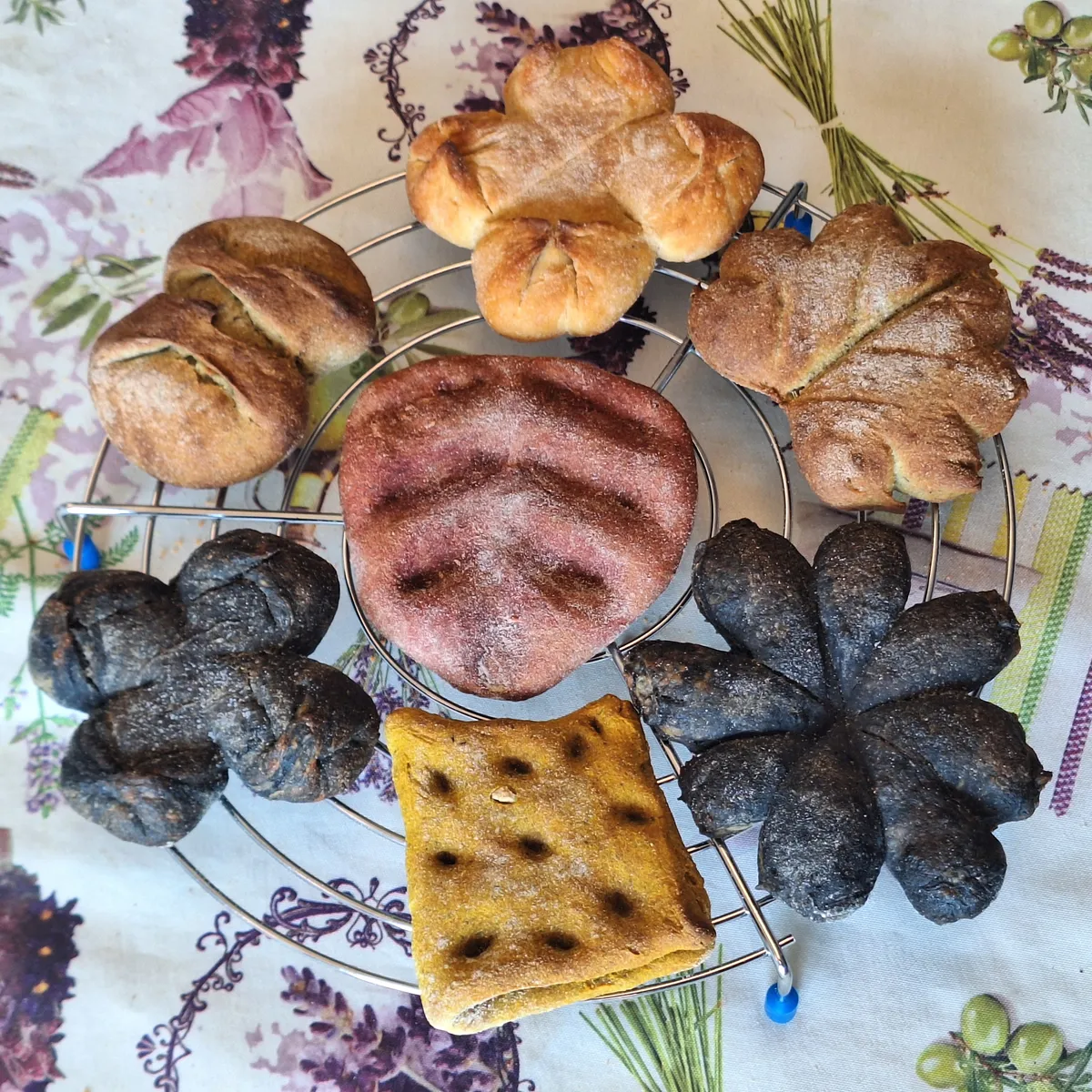
Rainbow Cloud Focaccine
1. Ingredients
| Ingredient | % | Quantity |
|---|---|---|
| Plain flour (type 0 or type 1) strong | 100% | 1000 g |
| Water | 78% | 780 g |
| Fine salt | 1% | 10 g |
| Extra-virgin olive oil | 2% | 20 g |
| Diastatic barley malt | 0.5% | 5 g |
| Active dry yeast | 0.4% | 4 g |
| (Optional) Dried oregano | to taste |
2. Water Roux (Tangzhong)
| Ingredient | % | Quantity |
|---|---|---|
| Flour from total | 7% | 70 g |
| Water from total | 35% | 350 g |
Mix the flour and water in a small saucepan. Cook over medium heat, stirring constantly, until it reaches 65 °C: the mixture thickens into a dense, gelatinous custard-like paste. Remove from heat and cool completely to room temperature before use. The tangzhong gelatinises the starch, which retains more water during baking and gives the crumb superior softness and moisture.
3. Method
For coloured focaccine: dissolve the chosen colorant in the water BEFORE adding the flour.
- Water Roux: whisk 70 g flour (of 1000 g total) and 350 g water (of 780 g total) in a small saucepan. Cook over medium heat, stirring constantly, until it reaches 65 °C: the mixture should thicken to the consistency of a thick custard. Remove from heat and cool to room temperature.
- Knead: in a large bowl combine the remaining 930 g flour (remaining, of 1000 g total), the remaining 430 g water (remaining, of 780 g total) and the cooled tangzhong. Add 5 g malt and 4 g yeast (dissolved in a small amount of water from the total). Knead for a couple of minutes to incorporate, then add 10 g salt and 20 g extra-virgin olive oil. Continue kneading until the flour and oil are fully absorbed. There is no need to achieve a smooth, round ball at this stage: that will come after the first fold. Cover the container with a lid or plate.
- Bulk rise: perform 3 stretch & folds every 30 minutes, then leave the dough covered at room temperature until it doubles in volume.
- Cold fermentation: lightly oil the bottom of the container (optional step, but helps release after fermentation). Cover and refrigerate for 12-24 h (up to 48 h possible).
- Shaping: divide the dough into 50-100 g pieces. Gently flatten into discs no more than 1 cm thick. Rest covered for 45-60 minutes at room temperature.
- Optional brine: emulsify water and oil in a 1:1 ratio by beating with a fork. Brush onto the surface of the focaccine, dock with a fork (optional), add dried oregano to taste.
- Baking: bake at 220 °C for about 15 minutes (adjust by eye: 2-3 minutes more for a crispier crust, less for softer focaccine).
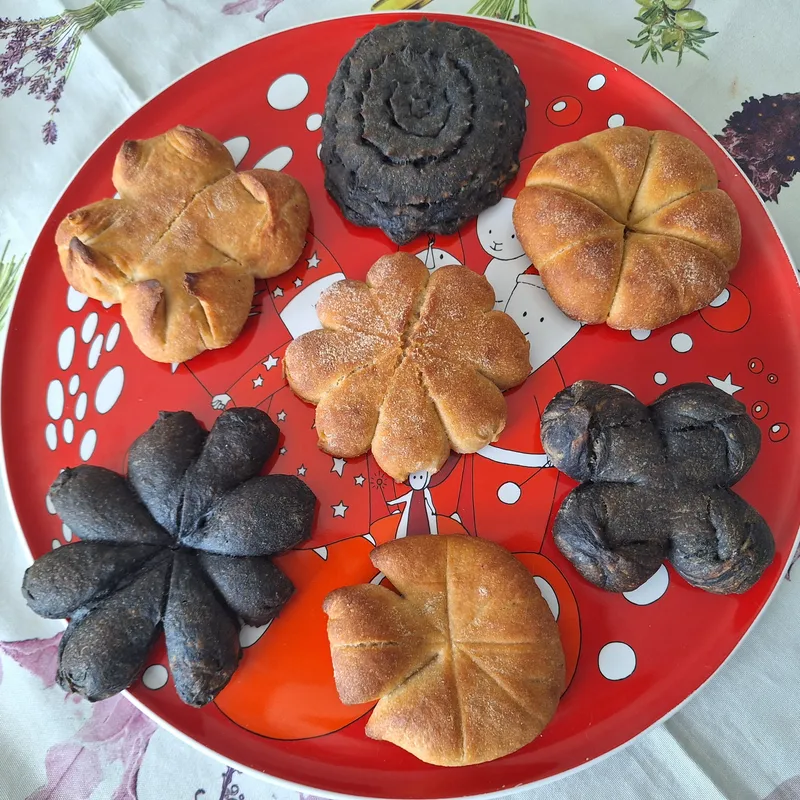
4. Natural Colorants
| Colorant | Dose/kg | Colour | Heat Stability |
|---|---|---|---|
| Turmeric | 10 g | Yellow | Excellent |
| Beetroot powder | 30 g | Pink-magenta | Low |
| Activated charcoal | 15 g | Black | Perfect |
| Cuttlefish ink | 10 g | Black | Perfect |
| Matcha | 20 g | Green | Good (≤220 °C) |
| Spinach powder | 30 g | Sage green | Moderate |
| Sweet paprika | 20 g | Orange | Good |
| Saffron | 0.5 g | Gold | Good |
5. Technical Effects of Colorants
| Colorant | Effect on Dough |
|---|---|
| Beetroot | Reduces extensibility; +2-3% water; reduce yeast 10% |
| Spinach | +1-2% water |
| Activated charcoal | None |
| Cuttlefish ink | None |
| Others | Minimal effect |
6. Technical Notes
- Hydration: this recipe specifies 78% hydration. It can be varied from 70% up to 80%. I advise against exceeding 80% because the dough becomes significantly harder to handle without noticeable benefits to the final product.
- Autolyse: autolyse consists of mixing flour and water and resting 20-60 minutes before adding yeast, salt and fats. During this rest the flour fully hydrates and gluten begins forming on its own, resulting in shorter kneading time and a more extensible, workable dough. In this recipe it is an optional step: to apply it, prepare the autolyse separately (remaining flour + remaining water, rest 20-60 minutes) and the water roux separately, then combine the two, add the yeast and finally salt and oil. I personally use it rarely: while it offers benefits, it makes the preparation somewhat too long and laborious, and with a strong type 0 flour the dough already achieves a sufficiently soft "cloud" texture without autolyse.
- Tangzhong (Water Roux): 7% of the total flour is used, mixed with water in a 1:5 ratio (flour:water). The mixture is cooked to 65 °C, the temperature at which starch gelatinises and absorbs roughly double the water compared to a traditional dough. The result is a softer crumb and a product that stays fresh longer. The usable range is 5-10% of total flour: higher percentages give an even softer crumb but a slightly stickier dough.
- Rustic variant: for a more rustic result without using the multi-flour blend from the Rustic Focaccine recipe, you can replace 25-50% of the type 0/type 1 flour with type 2 flour (semi-wholemeal). This gives a focaccina with more flavour and fibre but still soft thanks to the tangzhong.
- Salt: the base dose is 10 g per kg of flour (1%). For a more pronounced flavour you can go up to 20 g/kg (2%), which is still within the norm for savoury baked goods. Salt should be added separately from the yeast, never in direct contact with it.
- Oil: the base dose is 20 g per kg of flour (2%). It can be increased to 40 g/kg (4%) for better palatability, a softer crumb and longer shelf life. Oil should be incorporated at the end of kneading so as not to interfere with gluten formation.
Cuttlefish ink vs Activated charcoal
| Cuttlefish ink | Activated charcoal | |
|---|---|---|
| Composition | Natural melanin + minerals (iron, copper) | Wood/coconut charcoal activated at high temperature |
| Contraindications | None known | Reduces drug absorption by 47% if taken within 30 minutes |
| Health benefits | Antioxidant, mineral content | None documented for dietary use |
| Flavour | Neutral at the indicated dose (10 g/kg); doses above 15 g/kg may give a slight marine note | Completely neutral |
| Dose/kg | 10 g | 15 g |
I personally prefer cuttlefish ink: it gives the same intense black colour without the issues related to drug interaction, and also provides useful minerals. Activated charcoal is included in the colorants table for completeness, but I do not use it.
Diastatic malt vs Sugar/Honey
| Diastatic malt | Sugar / Honey | |
|---|---|---|
| Type of nourishment | Active enzymes (alpha and beta-amylase) + simple sugars | Simple sugars only (sucrose/fructose) |
| Mechanism | Enzymes progressively break down flour starch into maltose, providing continuous nourishment to the yeast throughout fermentation (12-48 h) | Provides immediately available sugars that the yeast depletes rapidly in the first hours |
| Osmotic effect | None | At high concentrations extracts water from yeast cells by osmosis, slowing fermentation |
| Long fermentation | Ideal: constant nourishment for 24-48 h+ | Unsuitable: after the initial boost there is no more nourishment |
| Maillard reaction | Produces reducing sugars → golden, aromatic crust | Surface caramelisation (darker colour but different flavour) |
| Effect on structure | No negative effect; improves crumb structure | Weakens gluten (liquefying effect) |
For long fermentations (12-48 h) diastatic malt is clearly preferable. Alternatively, sugar or honey can be used at the same dose (5 g/kg) or omitted entirely: fermentation will still work, but it will be less regular and the crust less golden.
7. Health Considerations
- Turmeric: curcumin is the main bioactive compound in turmeric and has well-documented anti-inflammatory properties. However, its bioavailability is naturally very low because it is rapidly metabolised by the liver. Adding piperine (the active compound in black pepper) increases curcumin bioavailability by approximately 20 times by inhibiting hepatic metabolism. For this reason, adding a pinch of ground black pepper to the turmeric dough is a simple but effective way to achieve a real anti-inflammatory benefit.
- Beetroot: beetroot powder is rich in inorganic nitrates, which are converted in the body into nitric oxide. Nitric oxide induces vasodilation, lowering blood pressure and improving circulation. Beetroot also contains betalains, pigments with antioxidant properties. Betalains are however heat-sensitive and partially degrade during baking.
- Activated charcoal: there are no documented health benefits for activated charcoal in dietary use at typical doses. Its only recognised medical use is as an antidote in acute poisoning by ingestion, due to its ability to adsorb toxic substances in the gastrointestinal tract. The same adsorption mechanism reduces drug absorption by 47% if taken within 30 minutes of consuming activated charcoal. For this reason it is not recommended for those who take medication regularly.
- Matcha: matcha is rich in catechins, particularly EGCG (epigallocatechin gallate), powerful antioxidants that help neutralise free radicals. Unlike many other heat-sensitive compounds, approximately 80% of matcha catechins survive baking at temperatures up to 220 °C, retaining much of their antioxidant potential even in the finished product.
- Spinach: spinach powder provides iron, folates and vitamin K. It also contains oxalates, which can reduce calcium absorption by binding to it in the gut. This is not a concern if the overall diet is varied and spinach is not relied upon as the sole source of calcium.
- Cuttlefish ink: cuttlefish ink is composed mainly of natural melanin and contains minerals such as iron and copper. It has antioxidant properties and presents no known contraindications. Its caloric contribution is negligible (approximately 60 kcal per 100 g of pure product, but at the doses used in this recipe the contribution is irrelevant). It is the preferred alternative to activated charcoal for achieving black colour without interference with drug absorption.
8. Storage
Let cool completely on a wire rack before storing.
- Room temperature: 3-4 days in a closed container. After this period the crumb firms up due to starch retrogradation and the surface dries out.
- Fridge: 4-5 days in a closed container, but not recommended because they become rubbery and dry out. They can be refreshed with a few minutes in the oven. If they need to be kept for 3-4+ days, it is better to freeze them.
- Freezer: up to 3 months. Thaw in the fridge or at room temperature. Reheat in the oven at 180 °C for 5 min.
9. Sources
- Shoba G et al. "Influence of piperine on the pharmacokinetics of curcumin in animals and human volunteers" — https://pubmed.ncbi.nlm.nih.gov/9619120/
- Hewlings SJ, Kalman DS. "Curcumin: A Review of Its Effects on Human Health" — https://pubmed.ncbi.nlm.nih.gov/29065496/
- Mirmiran P et al. "Functional properties of beetroot (Beta vulgaris) in management of cardio-metabolic diseases" — https://pubmed.ncbi.nlm.nih.gov/34200431/
- Jakubczyk K et al. "Enrichment of Biscuits with Matcha Green Tea Powder: Its Impact on Consumer Acceptability and Acute Metabolic Response" — https://doi.org/10.3390/foods7020017
- Juurlink BN. "Activated charcoal for acute overdose: a reappraisal" — https://pubmed.ncbi.nlm.nih.gov/15822758/
- Silberman J et al. "Activated Charcoal" — https://pubmed.ncbi.nlm.nih.gov/30415897/
- Kochman J et al. "Health Benefits and Chemical Composition of Matcha Green Tea: A Review" — https://www.ncbi.nlm.nih.gov/pmc/articles/PMC7796401/
- Tang G et al. "Spinach or carrots can supply significant amounts of vitamin A" — https://www.researchgate.net/publication/8945967
- Chainbaker. "How Does Sugar Affect Bread Dough?" — https://www.chainbaker.com/sugar-effect/
- Top Taste of Passion / Montanari, Giorilli. "Il malto è davvero sostituibile con zucchero o miele?" — https://www.top-tasteofpassion.it/il-malto-e-davvero-sostituibile-dallo-zucchero-o-dal-miele/
- Cookist / Palladini F. "Cos'è il malto diastasico e quali sono i suoi effetti nell'impasto della pizza" — https://www.cookist.it/cose-il-malto-diastasico-e-quali-sono-i-suoi-effetti-nellimpasto-della-pizza/