🍄 Mushroom Risotto: an in-depth guide
Technique and science of mushroom risotto: which mushrooms to choose, classic and plant-based mantecatura, plus a soy sauce and miso digression for the curious.
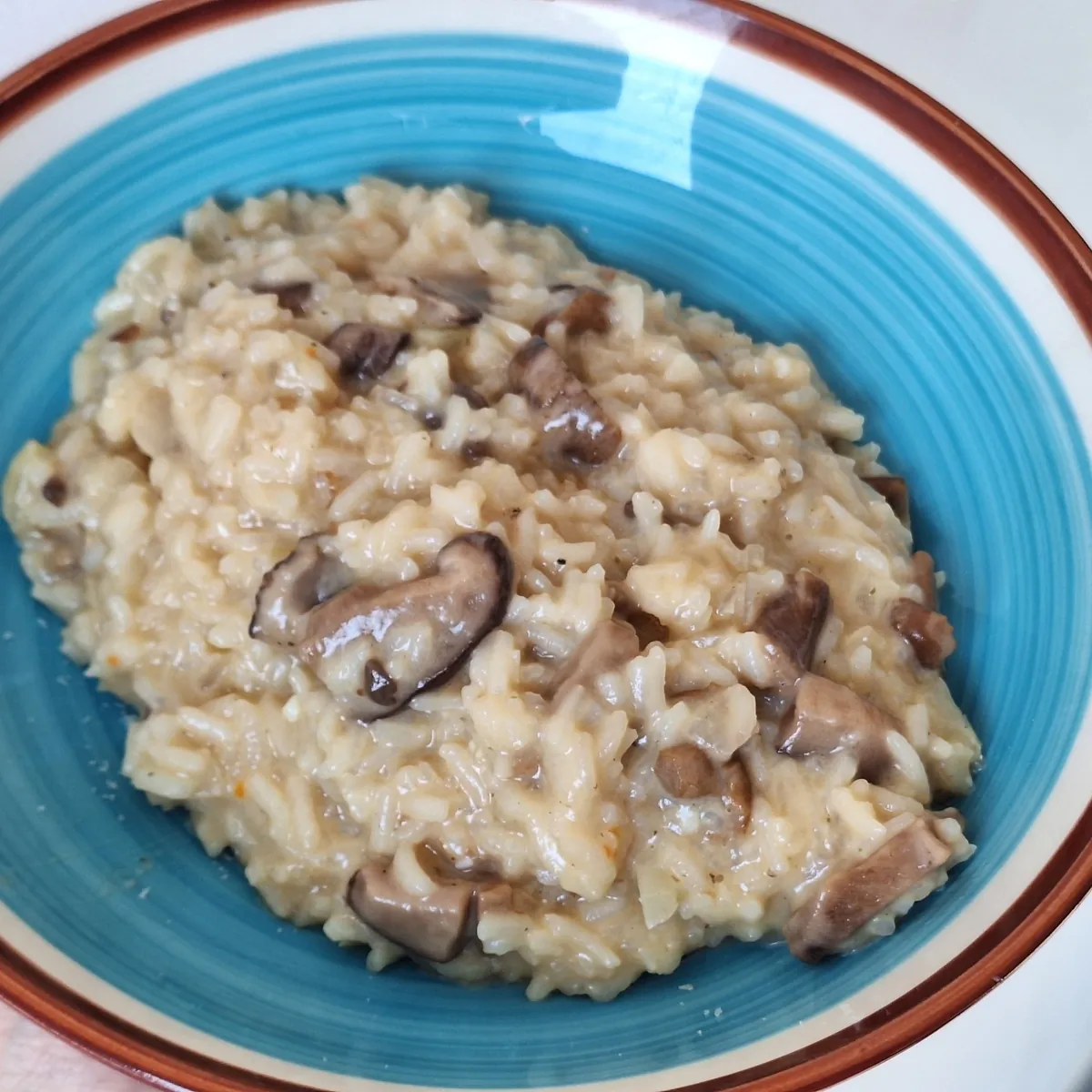
Mushroom Risotto: an in-depth guide
- 1. Ingredients
- 2. Step-by-step recipe
- 3. Cooking mushrooms separately: umami and depth
- 4. Toasting the rice
- 5. Adding stock and mushrooms
- 6. Mantecatura: butter, oil, Parmigiano
- 7. Plant-based mantecatura: alternatives to butter
- 8. A note on mushrooms: alternatives to porcini
- 9. A note on shallots: alternatives
- 10. A note on miso and soy sauce
- 11. Storage
- 12. Scientific evidence
1. Ingredients
Pan-seared mushrooms (separate pan, in order of addition)
| Ingredient | 8 | 6 | 4 | 2 | 1 |
|---|---|---|---|---|---|
| Extra-virgin olive oil (tbsp) | 4 | 3 | 2 | 1 | ½ |
| Fresh mushrooms: porcini, button, or see section below (g) | 600 | 450 | 300 | 150 | 75 |
| Dried porcini, rehydrated, optional (g) | 40 | 30 | 20 | 10 | 5 |
| Garlic, crushed (cloves) | 4 | 3 | 2 | 1 | ½ |
| Fresh thyme (sprigs) | 8 | 6 | 4 | 2 | 1 |
| Soy sauce, optional (ml) | 16 | 12 | 8 | 4 | 2 |
| White miso, optional (g) | 20 | 15 | 10 | 5 | 2.5 |
| Black pepper | to taste | to taste | to taste | to taste | to taste |
Risotto (saucepan, in order of addition)
| Ingredient | 8 | 6 | 4 | 2 | 1 |
|---|---|---|---|---|---|
| Extra-virgin olive oil (tbsp) | 4 | 3 | 2 | 1 | ½ |
| Shallot, finely chopped (pieces) | 4 | 3 | 2 | 1 | ½ |
| Carnaroli rice (g) | 640 | 480 | 320 | 160 | 80 |
| Dry white wine, or see alternatives below (ml) | 240 | 180 | 120 | 60 | 30 |
| Hot vegetable stock (ml) | 2800 | 2100 | 1400 | 700 | 350 |
| ← fold in the pan-seared mushrooms 3 min before end |
Mantecatura (off the heat, in order of addition)
| Ingredient | 8 | 6 | 4 | 2 | 1 |
|---|---|---|---|---|---|
| Cold butter, cubed, or see alternatives below (g) | 120 | 90 | 60 | 30 | 15 |
| Grated Parmigiano Reggiano (g) | 160 | 120 | 80 | 40 | 20 |
| Extra-virgin olive oil, raw, to finish (tbsp) | 4 | 3 | 2 | 1 | ½ |
| Fresh parsley, chopped, optional | to taste | to taste | to taste | to taste | to taste |
| Salt (only if needed after tasting) | to taste | to taste | to taste | to taste | to taste |
2. Step-by-step recipe
Preparation (before starting)
- Rehydrate dried porcini (optional, if using dried porcini): cover with 200 ml of hot water (not boiling) and leave for 20–30 minutes. Lift gently, squeeze out excess water; filter the soaking liquid through a fine-mesh sieve (or kitchen paper) and add it to the stock.
- Vegetable stock: bring to temperature and keep warm on low heat throughout cooking.
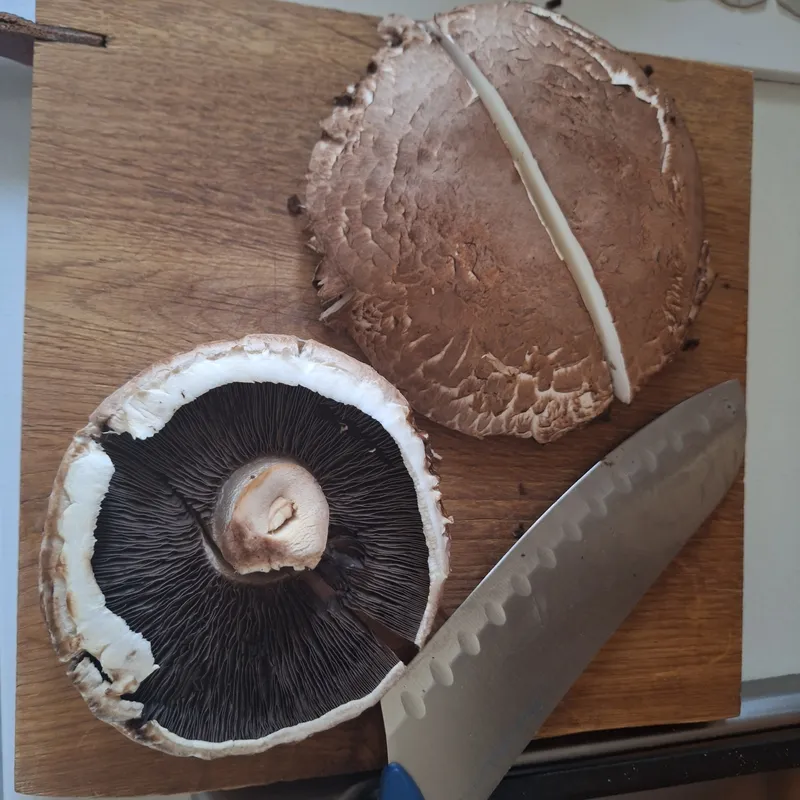
- Fresh mushrooms: clean with a damp cloth, cut into thick slices (~5 mm). Do not wash under running water.
- Shallot: mince finely.
- Phase 1 — Cooking the mushrooms (separate pan)
- Heat a wide pan over high heat with 2 tablespoons of extra-virgin olive oil (for 4 people; this is the mushroom-pan oil, separate from the rice oil).
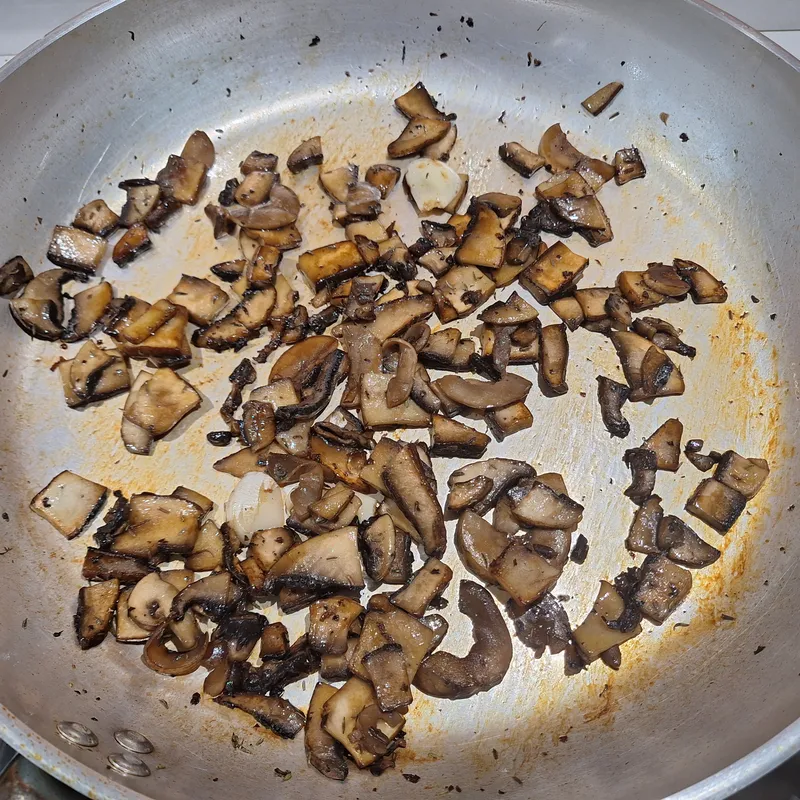
- Arrange the 300 g fresh mushrooms in a single layer (work in two batches if needed). Do not move them for 2–3 minutes until a golden crust forms.
- Flip, cook another 2 minutes.
- Add the 20 g rehydrated porcini, squeezed; cook 1 minute.
- Lower the heat; add 2 cloves crushed garlic and 4 sprigs thyme. Cook 30 seconds.
- Umami deglazing: deglaze with 8 ml soy sauce, stir for 15 seconds.
- Turn off the heat; dissolve 10 g white miso (optional) in the pan juices, stirring (miso must not be cooked at high heat or it loses aroma). Adjust pepper.
- Transfer mushrooms to a bowl and set aside. Reserve 2–3 tablespoons of pan juices.
- Phase 2 — Cooking the rice (separate saucepan)
- Heat 2 tablespoons of extra-virgin olive oil (for 4 people; this is the rice-saucepan oil) over medium heat.
- Sauté the 2 shallots, minced for 2–3 minutes until translucent (do not brown).
- Raise heat to medium-high. Pour the 320 g Carnaroli rice dry into the sautéed shallot.
- Toast the rice, stirring constantly for 2–3 minutes: the grains should turn translucent at the edges, hot to the touch, with a slightly nutty aroma. They must not colour.
- Deglaze with 120 ml dry white wine: pour in and stir until the alcohol evaporates completely (~1 minute; the hissing in the pan subsides).
- Lower to medium heat. Add one ladle of hot stock at a time (1400 ml vegetable stock in total for 4 people).
- Stir regularly (not obsessively; every 30–45 seconds is enough). Add the next ladle when the previous one is almost fully absorbed.
- Continue for about 14–15 minutes.
- When 3 minutes remain: fold in the sautéed mushrooms and their pan juices. Stir gently to incorporate without breaking them.
- Taste the rice: it should be al dente, with a slightly firm core.
- Phase 3 — Mantecatura
- Remove the saucepan from the heat.
- Immediately add 60 g cold butter, cubed, and 80 g grated Parmigiano.
- Do not stir with a spoon: grip the handle of the saucepan and push it back and forth vigorously, making the rice fold onto itself in a wave for 40–60 seconds, until a glossy, uniform cream forms.
- Cover with a lid and let rest 1–2 minutes.
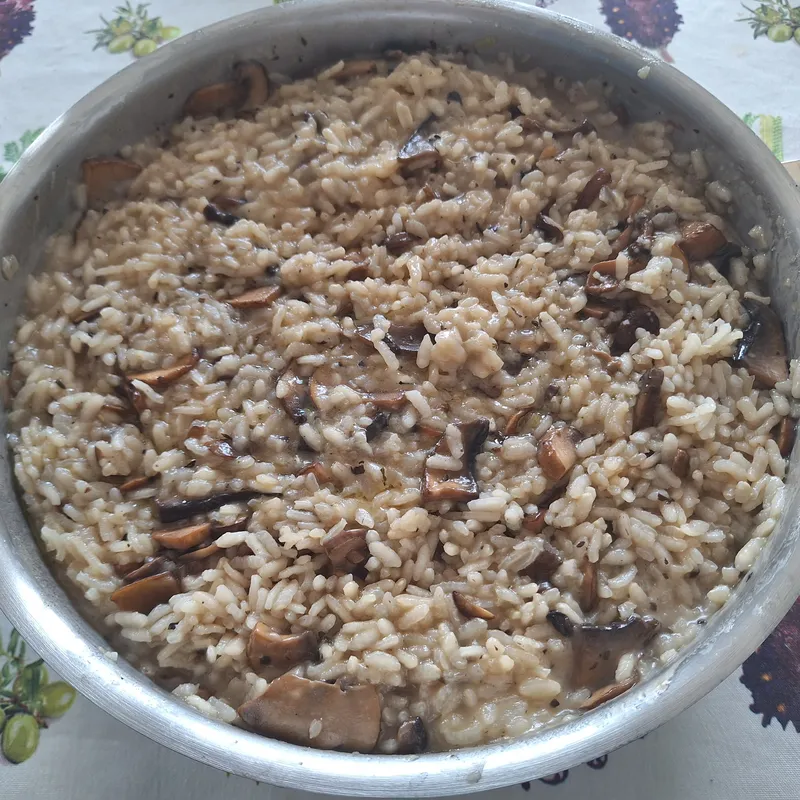
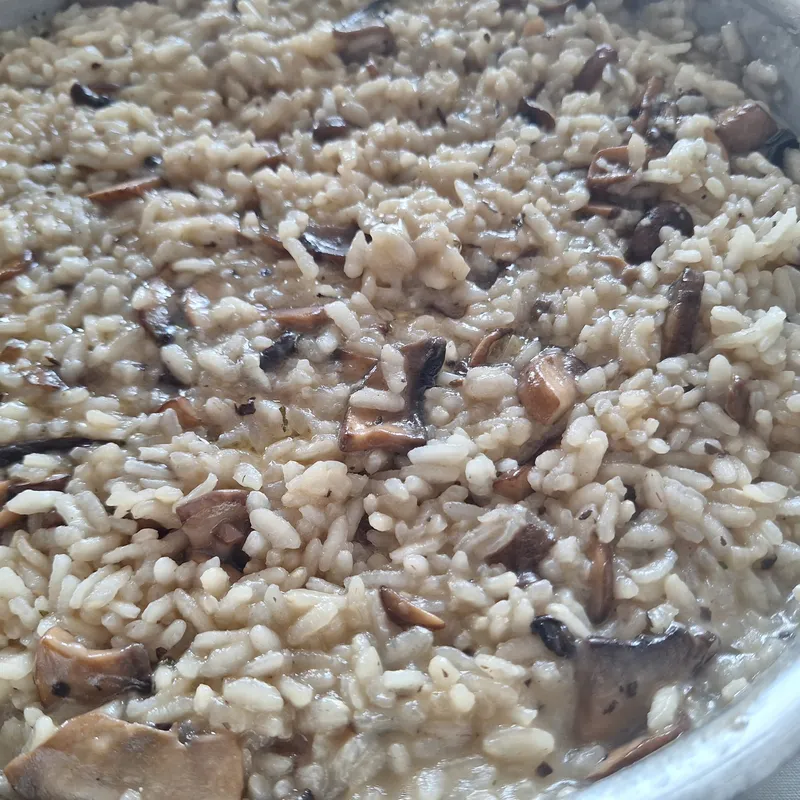
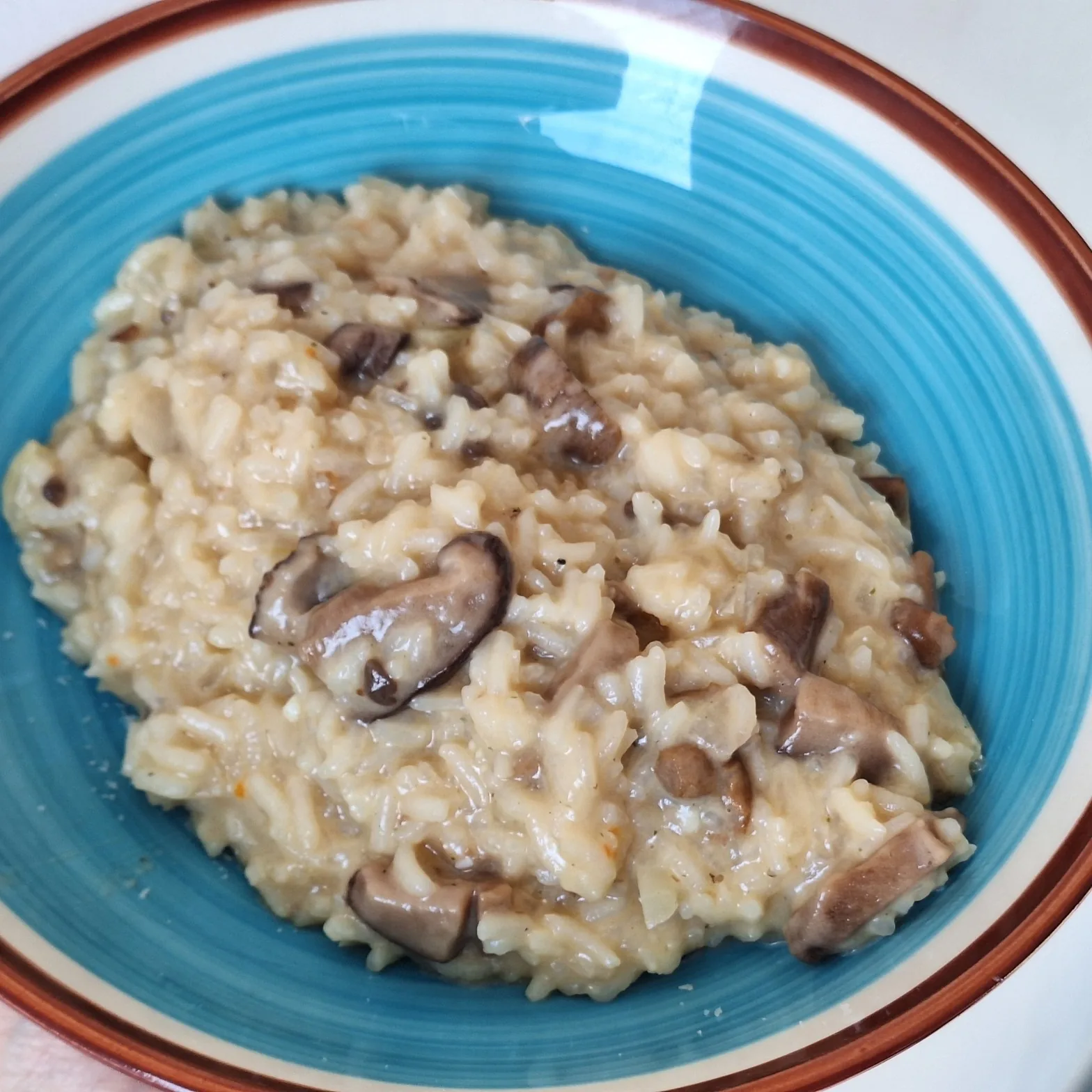
- Serve on a warm plate; the risotto should "flow" forming a wave (all'onda). If too thick, adjust with half a ladle of hot stock before plating.
- Taste and adjust salt only if needed: the Parmigiano and soy sauce are already salty, so extra salt is often unnecessary.
- Optional, to taste: finish with freshly chopped parsley, a drizzle of raw extra-virgin olive oil, and grated Parmigiano Reggiano.
3. Cooking mushrooms separately: umami and depth
Why cook them separately
Mushrooms contain ~90% water. Adding them raw to the risotto releases moisture into the rice uncontrollably, resulting in "boiled" mushrooms (grey, rubbery) and a watery risotto. Cooking them separately in a very hot pan enables the Maillard reaction: surface water evaporates, proteins and sugars caramelise creating the golden crust and intense flavour we seek.
Ingredients to boost umami and depth
| Ingredient | Function | When to add |
|---|---|---|
| Soy sauce (a few drops) | Free glutamic acid; noticeably boosts umami compared to salt alone | At end of mushroom cooking, as deglazing |
| White miso (shiro miso) | Second layer of fermented umami + body | Off heat, dissolved in the hot pan juices |
| Garlic (crushed) | Aromatics without risk of burning | Last 30–60 seconds of mushroom cooking |
| Fresh thyme | Terpenic compounds that enhance earthy porcini notes | With garlic, last 30 seconds |
Order of addition in the pan
- Extra-virgin olive oil → smoking-hot pan
- Fresh mushrooms → single layer, undisturbed 2–3 min per side
- Rehydrated mushrooms → 1 minute (already soft)
- Garlic + thyme → 30 seconds (heat lowered)
- Soy sauce → deglazing 15 sec
- Miso → off heat, dissolved in pan juices
4. Toasting the rice
What happens during toasting
Toasting is the step where rice grains, heated to 140–160 °C for 2–3 minutes, undergo a "sealing" of the outer starch layer. Surface amylopectin partially gelatinises, forming a barrier that: prevents grains from falling apart during cooking; enables gradual starch release into the stock (creaminess without stickiness); generates nutty aromatic compounds (mild Maillard on starch).
How long and with which ingredients
2–3 minutes over medium-high heat, stirring constantly. Visual cue: grain edges turn from opaque to translucent/glassy; the centre remains white. If grains start to colour, the heat was too high. Use extra-virgin olive oil for toasting (the dominant flavour should be the mushroom, not butter; save butter for mantecatura). The shallot should be sautéed before adding the rice.
Deglazing with wine
Immediately after toasting: white wine lowers the grain temperature, "locks in" the toasting and adds acidity that balances the mushroom umami. It must evaporate completely before adding stock; residual alcohol would make the dish bitter.
White wine substitutes
If wine is unavailable (or by choice), deglazing serves two functions: rapidly lowering the temperature of the toasted rice and providing acidity. Any substitute must replicate both effects.
| Substitute | Dose (for 2 people, 160g rice) | When and how |
|---|---|---|
| Dry vermouth | 60 ml (same dose as wine) | Identical to wine; more aromatic, evaporates in the same time |
| Hot stock + lemon juice | 45 ml stock + 15 ml lemon juice (~½ lemon) | Pour stock for thermal shock, add lemon right after; don't cook lemon too long (bitterness) |
| Diluted apple cider vinegar | 10 ml apple cider vinegar (~2 teaspoons) + 50 ml hot stock | Mix before pouring; pure vinegar is too aggressive (apple cider vinegar is significantly more acidic than wine). Evaporate completely before adding more stock |
| Omit entirely | One ladle of hot stock | You lose the acidity that balances umami; compensate with a few drops of lemon in the final mantecatura |
5. Adding stock and mushrooms
The stock must be hot (nearly simmering): adding cold liquid interrupts cooking and produces a hard-core/soft-outside grain. One ladle at a time: the rice must cook gradually in the liquid, not boil submerged. Stir every 30–45 seconds. Total time from first ladle: 16–18 minutes for Carnaroli, 14–16 for Arborio.
When to add the mushrooms
3 minutes before the rice finishes cooking. The mushrooms are already cooked and only need to warm up and release their aromas into the risotto without losing texture. Adding them too early makes them mushy; too late and they don't release flavour. Also add the pan juices from the mushroom pan.
6. Mantecatura: butter, oil, Parmigiano
What is mantecatura
It is the final emulsion of cold fat + cheese into the hot, starchy rice mass. The starch released during cooking acts as a natural emulsifier, binding fat into micro-droplets and creating a glossy, velvety, stable cream.
The movement technique
- Pan off the heat.
- Cold butter, cubed + fine Parmigiano on top of rice.
- Grip the saucepan handle firmly.
- Push back and forth vigorously, making the rice fold onto itself in a wave.
- Continue for 40–60 seconds until the surface is glossy and uniform.
- Rest 1–2 minutes covered before plating.
Consistency at mantecatura time
Remove the rice from heat when it is slightly more liquid than you want on the plate. Mantecatura and resting will thicken it. The risotto on the plate should "flow" when you tilt it: this is the famous all'onda.
7. Plant-based mantecatura: alternatives to butter
For those avoiding dairy or seeking a different lipid profile, mantecatura can be done with plant-based fats. The physical principle remains identical: a cold (or room-temperature) fat emulsified into the hot rice starch.
| Alternative | Dose (for 2 people) | Pros | Cons |
|---|---|---|---|
| Cold extra-virgin olive oil | 2 tablespoons | Clean flavour; enhances mushrooms without competing; no allergens | Less creamy than butter; doesn't emulsify with the same density |
| Almond cream | 1.5 tablespoons | Creaminess similar to butter; delicate almond aftertaste | Allergen (tree nuts); slightly sweet |
| Cashew cream | 1.5 tablespoons | Very neutral; closest to butter in body | Allergen (tree nuts); expensive |
| Ripe avocado | ½ avocado, mashed | Monounsaturated fats; silky texture | Greenish colour; noticeable flavour that not everyone appreciates |
| Plant-based butter | 30 g | Drop-in replacement; same technique as butter | Ultra-processed; variable quality by brand; often contains palm oil |
EVO oil: room temperature or frozen?
The physics of mantecatura require thermal shock: cold fat meeting hot starch; the starch wraps fat micro-droplets forming a stable, creamy emulsion. With butter this happens naturally (it's solid at 4 °C). With EVO oil, which is liquid at room temperature, you can replicate the same effect by freezing the oil into cubes (pour it into an ice-cube tray a few hours ahead). The cube melts gradually in the hot rice and the starch captures it progressively, producing a result closer to classic mantecatura.
| Method | Result | When to choose it |
|---|---|---|
| Frozen EVO oil cubes | More stable emulsion; "fondant" and creamy result, similar to butter | When you want to replicate classic mantecatura texture without dairy |
| Room-temperature EVO oil (drizzled) | Less stable emulsion; "glossy and flowing" result rather than fondant | When you prefer simplicity and accept a less bound risotto, more like a raw dressing |
Nutritional comparison: butter vs EVO oil
| Parameter | Butter (30 g) | EVO oil (2 tbsp, ~28 g) |
|---|---|---|
| Calories | ~215 kcal | ~248 kcal |
| Saturated fats | ~15 g (51%) | ~4 g (14%) |
| Monounsaturated fats | ~7 g | ~20 g |
| Cholesterol | ~60 mg | 0 mg |
| Polyphenols | Absent | Present (oleocanthal, oleuropein) |
| Vitamin A | Present | Traces (beta-carotene) |
8. A note on mushrooms: alternatives to porcini
Fresh porcini are seasonal (late summer–autumn) and expensive. When unavailable, the best combination is fresh champignon mushrooms + a small bag of dried porcini. Champignons provide mass and meaty texture; dried porcini (rehydrated 20 min in hot, not boiling, water) provide the intense earthy aroma. The soaking water, filtered through a fine-mesh strainer, becomes part of the cooking stock.
| Alternative | Pros | Cons |
|---|---|---|
| Champignon + dried porcini | Available year-round; excellent flavour-to-cost ratio | Less "noble" texture than fresh porcini |
| Pioppini (Agrocybe aegerita) | Bold flavour, good consistency | Not always available |
| Chanterelles (Cantharellus) | Unique fruity/peppery aroma | Different profile from porcini: a "different" risotto, not inferior |
| King oyster (Pleurotus eryngii) | Exceptional meaty texture | Delicate aroma; needs more umami from other sources |
| Frozen mushroom mix | Convenient, always available | Variable quality; releases a lot of water |
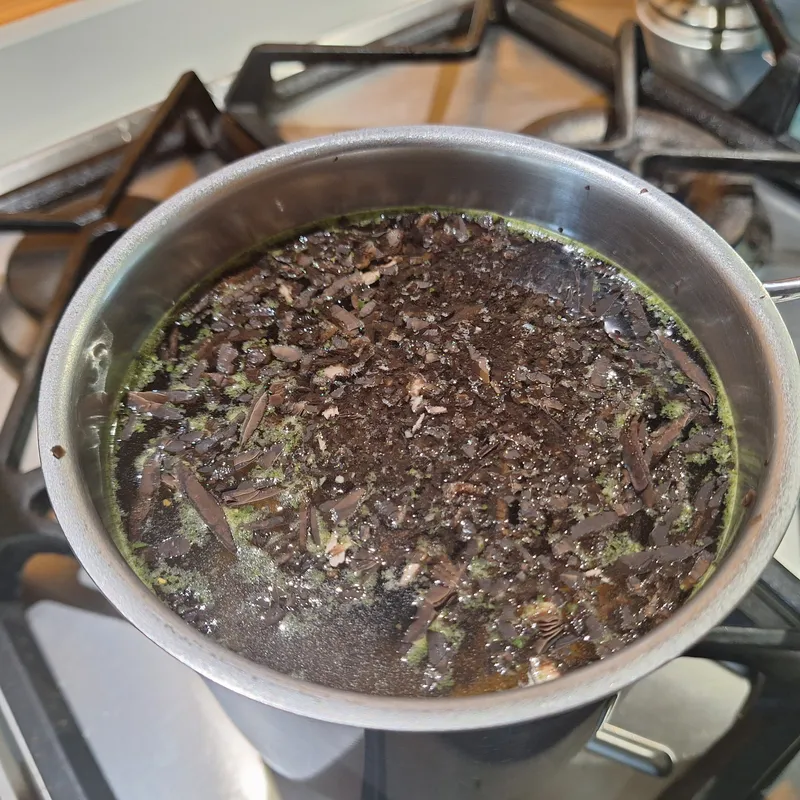
| Portobello (mature Agaricus bisporus) | High umami; meaty texture; always available | Dark gills release black liquid (aesthetics), slightly bitter aftertaste, gritty texture; scrape gills and add them to stock to recover umami |
Mushroom mixes: how to combine them
Mixes are possible and often advisable, but you must consider each mushroom's contribution. Free glutamate (responsible for umami) varies enormously between species: fresh champignons contain only 40–110 mg/100g (Umami Information Center), while dried shiitake reach 1060 mg/100g glutamate and 150 mg/100g guanylate (a nucleotide that amplifies glutamate's umami up to 8-fold); dried porcini are also rich in it, though published data are less well-established than for shiitake. Champignons alone produce a flat, bland risotto; they should always be combined with high-umami mushrooms. Effective combinations:
| Mix | Why it works |
|---|---|
| Champignon + dried porcini | Champignons provide mass and texture; dried porcini provide aroma and guanylate that multiplies umami |
| Champignon + dried shiitake | Same principle; shiitake bring concentrated glutamate (1060 mg/100g) and guanylate (150 mg/100g) |
| Pioppini + portobello | Pioppini bring savouriness and firm texture; portobello brings volume, medium-high umami and meaty texture |
9. A note on shallots: alternatives
Shallot is the classic base for mushroom risotto: sweet, delicate, unobtrusive flavour. But it's not always available or the flavour might not be preferred. Here are the alternatives.
| Alternative | Tips | Pros | Cons |
|---|---|---|---|
| White or golden onion | Mince very finely; sauté longer (5–6 min) to sweeten | Always available, inexpensive | Stronger, more pungent flavour than shallot |
| Spring onions (white part only) | Slice into thin rounds; brief sauté (2 min) | Delicate, almost like shallot | Seasonal; the green part doesn't go into the sauté base |
| Red onion | — | — | Not recommended: purple colour unaesthetic in white risotto, overly characterising flavour |
10. A note on miso and soy sauce
Tradition and context
Neither miso nor soy sauce belong to Italian or European culinary tradition. Miso is a Japanese fermented seasoning (of Chinese origin, later attested in Japan); soy sauce reached Europe in the 16th–17th century via Portuguese and Dutch trade routes, without ever integrating into traditional European cooking. Soy sauce and miso are not used in a classic mushroom risotto. They are mentioned in this recipe to give an extra boost of savouriness, especially if using "weaker" mushrooms, but both are entirely optional.
Soy sauce: what it does
Soy sauce is a concentrated solution of free glutamate. Added during mushroom deglazing, it amplifies the umami already present: the effect is not merely additive, soy glutamate acts synergistically with the mushrooms, multiplying the perception of savouriness. The result is a more intense, "deeper" mushroom fond, without adding any recognisable soy flavour. The flavour-to-quantity ratio is excellent: a few drops produce a significant effect. It can be omitted entirely if using mushrooms with an already high umami profile (porcini, shiitake, portobello); Parmigiano in the mantecatura partially compensates, being naturally rich in glutamate from ageing.
Miso: what it does
Miso adds a second layer of umami, qualitatively different from soy sauce: rounder, with fermented complexity (nutty, earthy notes in shiro miso). Fermentation breaks down about 30% of soy proteins into free amino acids, with glutamate as the dominant component. In practice, the finished dish gains a more enveloping "fullness" of flavour; the risotto feels richer and more complex without any specific ingredient being identifiable. This is the more optional step of the two: soy sauce alone works perfectly; without miso, simply increase the soy dose by 50% (from a few drops to half a teaspoon for 2 people).
Which miso to use
For this risotto use shiro miso (white/yellow miso): short fermentation, sweet-delicate flavour that doesn't overpower the mushrooms. Avoid red miso (aka miso) or barley miso (mugi miso): too intense and dark, they would compete with porcini.
11. Storage
Let the risotto cool to room temperature for no more than 30-40 minutes before refrigerating: sealing it airtight while still warm traps steam and creates a humid environment favourable to bacteria.
- Room temperature: maximum 2 hours after cooking is complete. Cooked rice is an ideal medium for Bacillus cereus proliferation (a bacterium that produces heat-stable toxins); beyond 2 hours at room temperature the risk becomes significant.
- Refrigerator: 2–3 days in an airtight container. To reheat: add 2–3 tablespoons of hot stock per portion and warm over medium heat while stirring; the texture will be slightly firmer than the original but still good.
- Freezer: up to 1 month, portioned into airtight containers. Thawing and reheating make the grains softer and less "al dente"; the risotto loses its all'onda consistency. Acceptable for convenience, but the result is inferior to fresh.
12. Scientific evidence
- Guasch-Ferré M. et al. (2014). "Olive oil intake and risk of cardiovascular disease and mortality in the PREDIMED Study." BMC Medicine, 12:78. — Inverse association between EVO oil consumption and cardiovascular mortality.
- Schwingshackl L. & Hoffmann G. (2014). "Monounsaturated fatty acids, olive oil and health status." Current Pharmaceutical Design, 20(5):843–849. — Review of anti-inflammatory mechanisms of oleic acid.
- Beauchamp G.K. et al. (2005). "Phytochemistry: Ibuprofen-like activity in extra-virgin olive oil." Nature, 437:45–46. — Discovery of oleocanthal as anti-inflammatory.
- De Souza R.J. et al. (2015). "Intake of saturated and trans unsaturated fatty acids and risk of all cause mortality." BMJ, 351:h3978. — Meta-analysis: replacing saturated fats with monounsaturated reduces risk.
- Fernández del Río L. et al. (2016). "Olive oil polyphenols and cardiovascular diseases." Frontiers in Nutrition, 3:29. — Cardioprotective mechanisms of oil polyphenols.
- Nocella C. et al. (2018). "Extra Virgin Olive Oil and Cardiovascular Diseases: Benefits for Human Health." Endocrine, Metabolic & Immune Disorders Drug Targets, 18(1):4–13. — Effects on oxidative stress and endothelial function.