🎃 Pumpkin Risotto: an in-depth guide
Recipe and basics for making pumpkin risotto: oven or microwave pumpkin, shallot base and alternatives, possible mantecatura options, and a little-known fact about deglazing with wine.
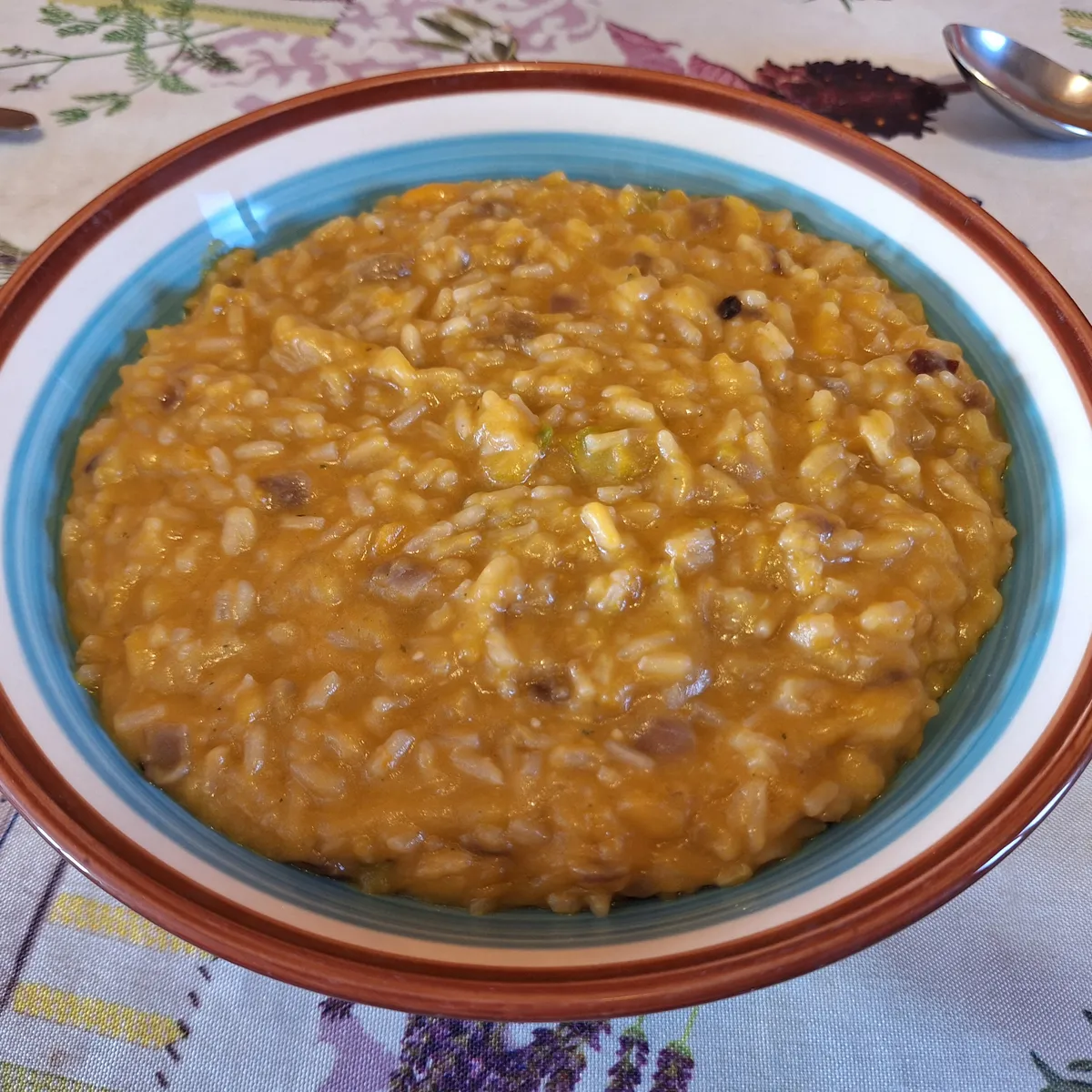
Pumpkin Risotto: an in-depth guide
1. Ingredients
Risotto (saucepan, in order of addition)
| Ingredient | Quantity |
|---|---|
| Delica or Mantovana pumpkin, trimmed raw | 650 g |
| Extra-virgin olive oil (for the base) | 25 g (about 2 tbsp) |
| Shallot, finely chopped (or 1 medium onion per 4 people) | 2 |
| Carnaroli rice | 320 g |
| Dry white wine, optional, or see alternatives | 120 ml |
| Hot vegetable stock | 1400 ml |
Halfway through cooking, fold in the cooked, mashed pumpkin (see method).
Mantecatura (off the heat, in order of addition)
| Ingredient | Quantity |
|---|---|
| Extra-virgin olive oil, ideally frozen cubes | 60 g |
| Grated Parmigiano Reggiano | 120 g |
| Salt (only if needed after tasting) | to taste |
2. Method
- Phase 1 — Cooking the pumpkin (separately)
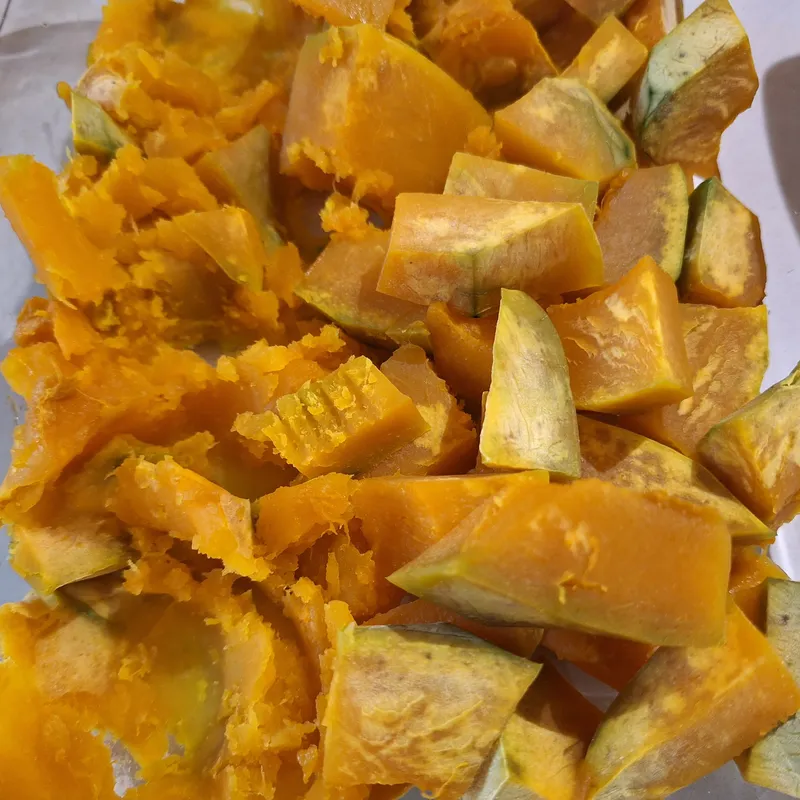
- Clean the 650 g pumpkin: remove skin and seeds, cut into cubes of about 2-3 cm. Weigh it trimmed and raw (see the technical section for the difference between raw and cooked weight).
- Cook it with one of two methods (see the dedicated section for pros and cons):
- Microwave (fast): put the pumpkin pieces in a microwave-safe container (glass or ceramic is best, avoid plastic), a splash of water on the bottom, cover with a microwave-safe lid (an ordinary ceramic plate works too), 8-10 minutes at full power until the pumpkin is soft, then a few minutes of rest.
- Oven (better flavour): spread the cubes on a tray with 1 tablespoon extra-virgin olive oil, salt and pepper, and roast at 200 °C for 25-35 minutes until tender and lightly golden.
- If microwaved, drain off the excess water well. Then, in any case, mash about two thirds of the pumpkin into a coarse purée; leave the rest in cubes, so the dish has both creaminess and recognisable pieces. Alternatively you can mash all of it and have no pumpkin pieces in the risotto.
- Phase 2 — Base and toasting the rice
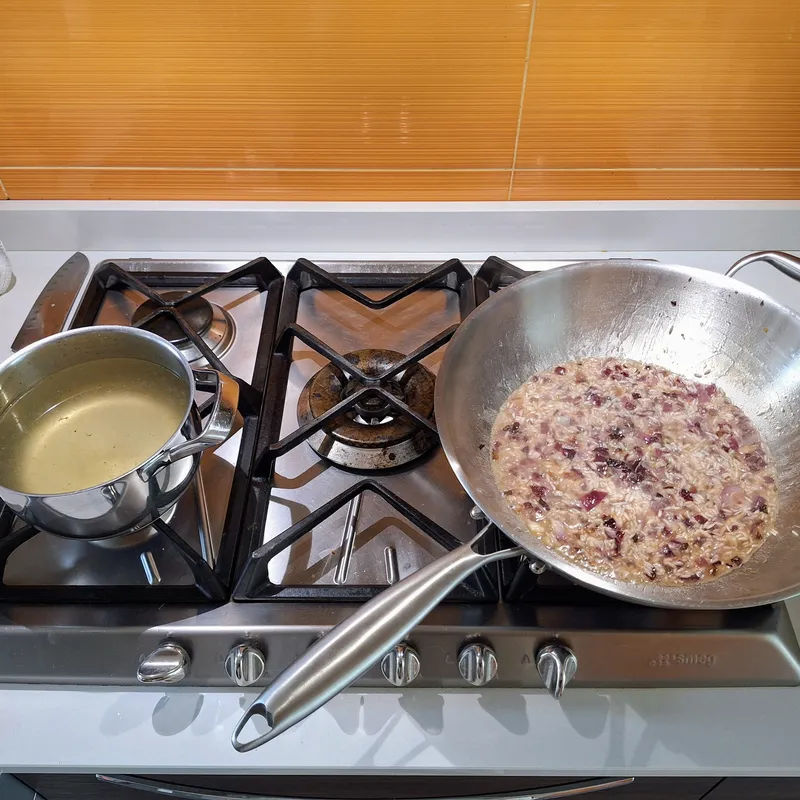
- Vegetable stock: bring it to temperature and keep it warm on low heat throughout cooking.
- In a saucepan, heat 2 tablespoons extra-virgin olive oil over medium heat.
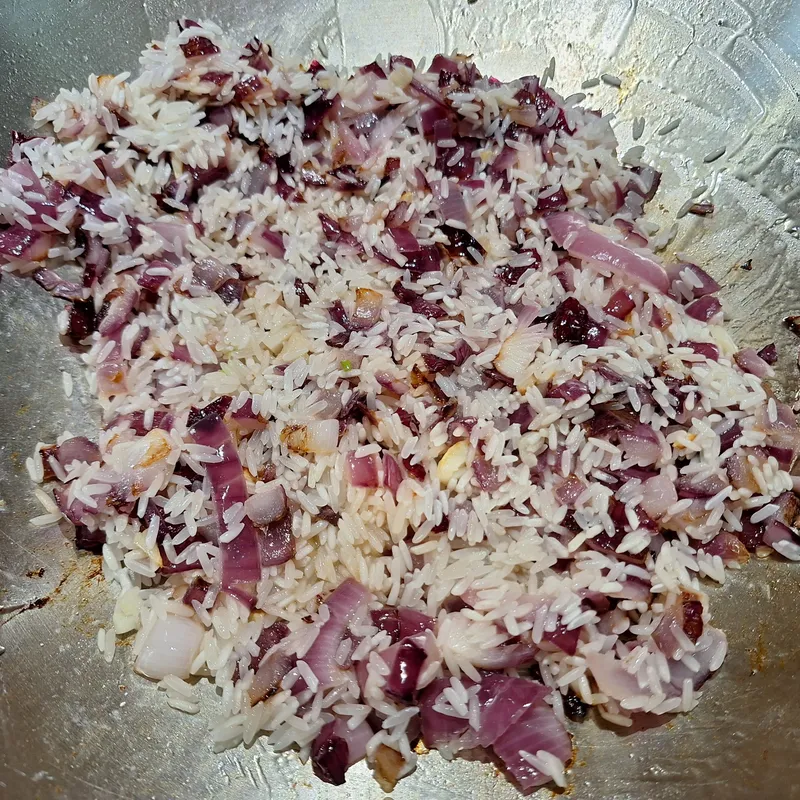
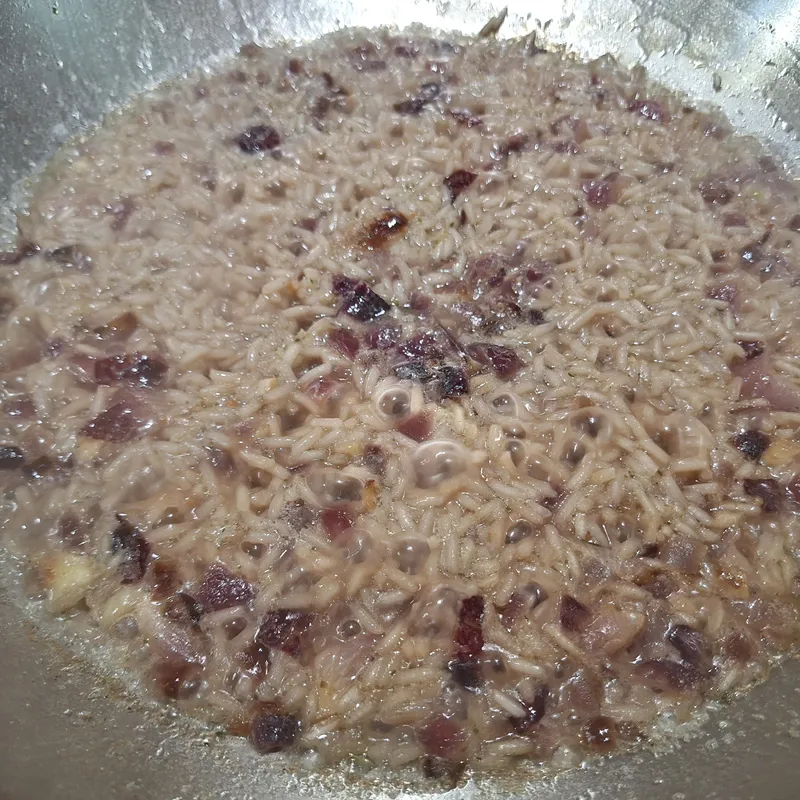
- Sauté the 2 shallots, chopped (or 1 medium onion) for 2-3 minutes until translucent, without colouring. If using onion instead of shallot, extend the sauté to 5-6 minutes over low heat to sweeten it (see technical section).
- Raise the heat to medium-high. Pour the 320 g Carnaroli rice dry into the base.
- Toast the rice, stirring constantly for 2-3 minutes: the grains should turn translucent at the edges, hot to the touch, with a slightly nutty aroma. They must not colour.
- Optional, deglazing: deglaze with 120 ml dry white wine and stir until it evaporates (about 1 minute; the hissing in the pan subsides). For a risotto suitable for children you can omit the wine and deglaze with a ladle of stock (see the technical section on residual alcohol).
- Phase 3 — Cooking and adding the pumpkin
- Lower to medium heat. Add one ladle of hot vegetable stock at a time.
- Stir regularly (every 30-45 seconds is enough). Add the next ladle when the previous one is almost fully absorbed.
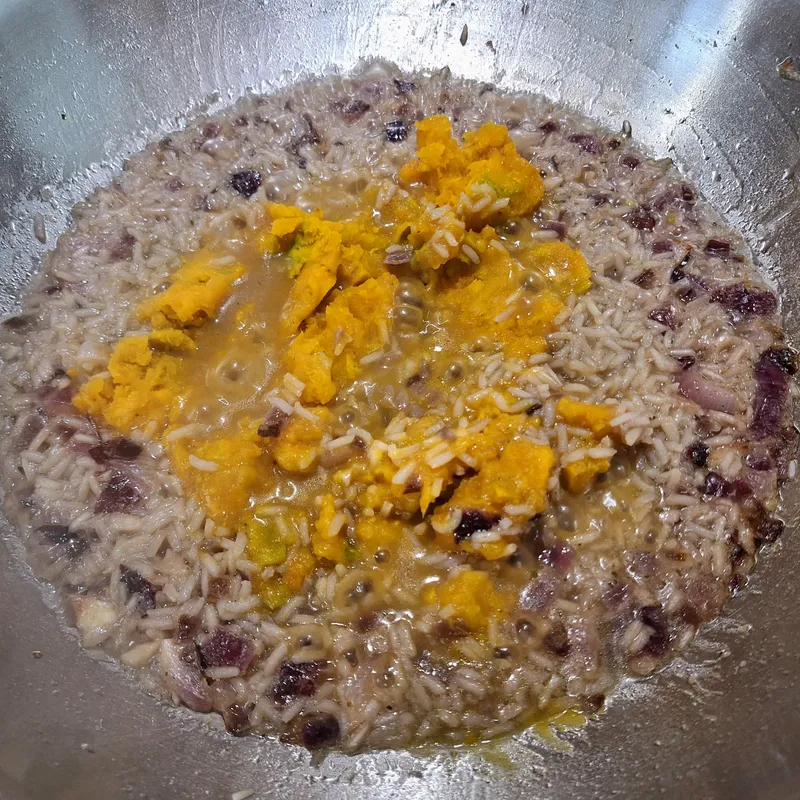
- At about halfway through cooking (after 8-9 minutes) fold in the cooked, mashed pumpkin with its cubes. Stir to incorporate: the purée gives colour and creaminess, the cubes stay recognisable.
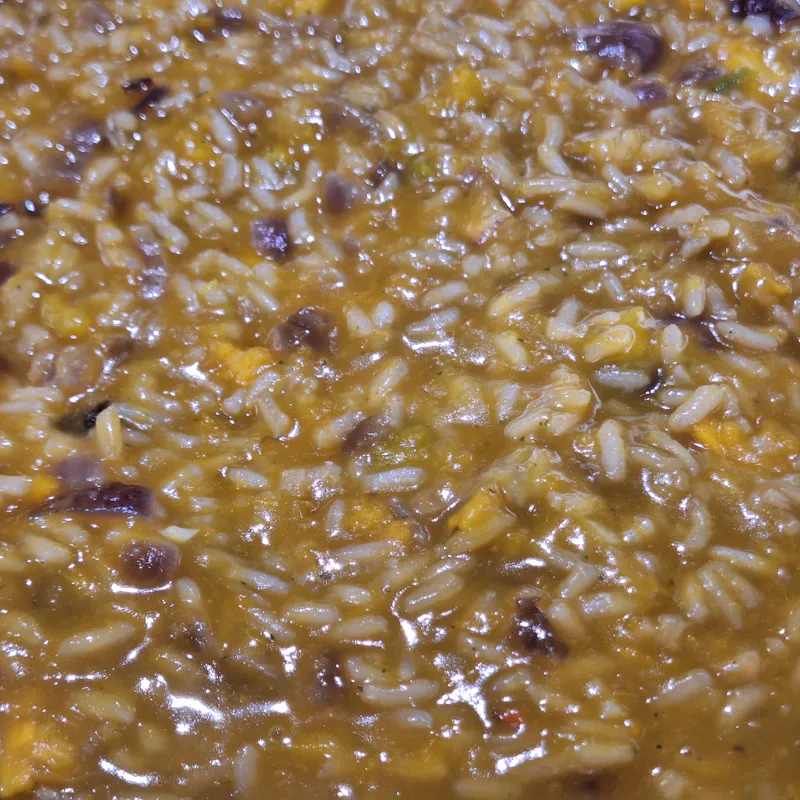
- Continue with the stock for another 7-8 minutes. Taste the rice: it should be al dente, with a slightly firm core.
- Phase 4 — Mantecatura
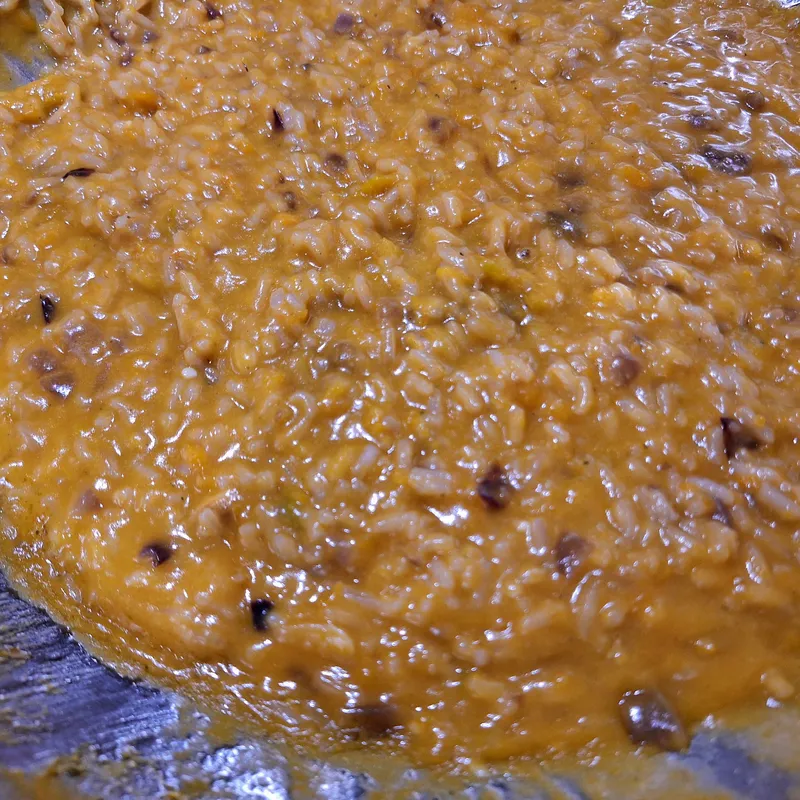
- Remove the saucepan from the heat. The rice should be slightly more liquid than you want on the plate: mantecatura and resting will thicken it.
- Immediately add the 60 g extra-virgin olive oil (ideally frozen cubes) and the 120 g grated Parmigiano.
- Do not stir with a spoon: grip the handle of the saucepan and push it back and forth vigorously, making the rice fold onto itself in a wave for 40-60 seconds, until a glossy, uniform cream forms.
- Cover with a lid and let rest 1-2 minutes.
- Taste and adjust salt only if needed: the Parmigiano is already salty. Serve on a warm plate; the risotto should "flow" forming a wave (all'onda). If too thick, adjust with a little hot stock before plating.
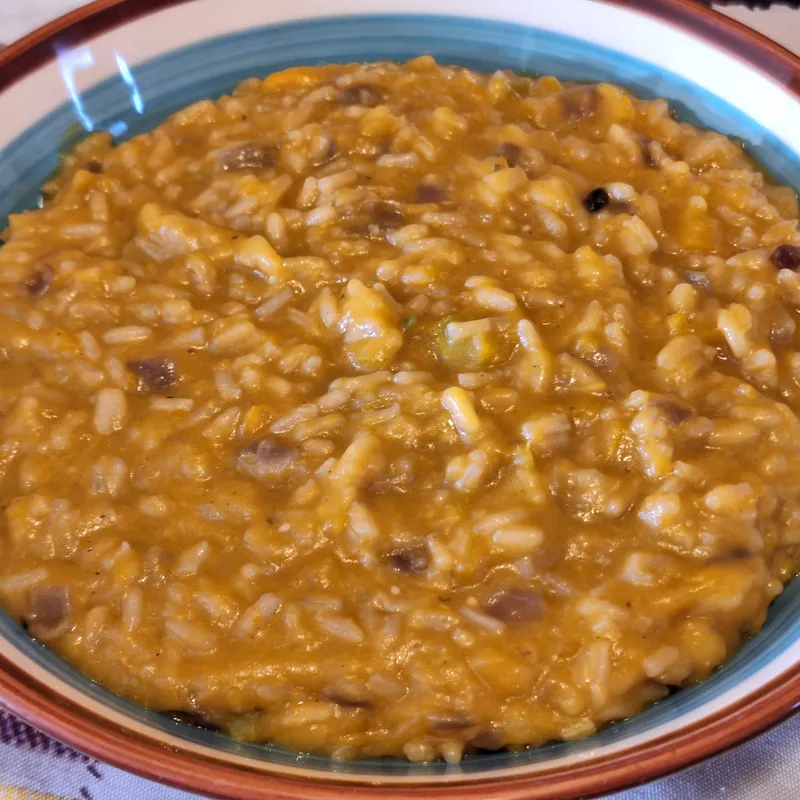
3. Cooking the pumpkin: oven or microwave
Raw weight and cooked weight
The amount of pumpkin in this recipe (650 g for 4 people) is meant as trimmed, raw weight: the cleaned pumpkin, without skin or seeds, before cooking. During cooking the pumpkin loses water and drops in weight and volume; the same pumpkin cooked weighs less. Always weighing it raw and trimmed is the only way to have a comparable, repeatable quantity.
The two methods compared
The difference between the two methods is a matter of temperature and water. In the microwave the waves excite the water inside the pieces, which cook "from the inside" in their own steam; the temperature does not exceed about 100 °C, so the pumpkin stays more moist and does not brown. In the oven the dry heat brings the surface above 130 °C: water evaporates and the Maillard reaction and sugar caramelisation kick in, giving drier, golden pieces with a more concentrated flavour.
For the risotto, a drier pumpkin (oven) releases less water into the rice and allows better control of stock absorption, with a more concentrated flavour. A microwaved pumpkin stays more moist: excellent and much faster, it just needs draining well before adding it to the rice. Both methods give a good risotto; what changes is the time required and the concentration of flavour.
| Criterion | Microwave | Oven (200 °C) |
|---|---|---|
| Time (for ~500-600 g cubed) | 6-10 min + 2 min rest | 25-35 min |
| Flesh temperature | up to ~100 °C | surface above 130 °C |
| Resulting moisture | higher (stays watery) | lower (dry) |
| Flavour | clean, sweet, less concentrated | caramelised, toasted, deeper |
| Browning (Maillard) | absent | present |
| When to choose it | faster, fewer steps | top-tier risotto, more pronounced flavour |
Which pumpkin variety
The discriminant for risotto is the water content of the flesh: a firm, dry-fleshed pumpkin does not water down the rice and almost mantecas on its own, while a watery pumpkin releases liquid and requires more drying in the oven and less stock. The colour the pumpkin gives the dish also varies.
| Variety | Water / texture | Sweetness and flavour | Behaviour in risotto | Tips and colour |
|---|---|---|---|---|
| Delica (kabocha) | Dry, firm | Very sweet, chestnut notes | Excellent: mantecas almost on its own, no watering | The most suitable; warm orange |
| Mantovana / Cappello del prete | Floury, dry | Sweet, rustic flavour | Excellent hold, full-bodied risotto | Very suitable; matte orange |
| Butternut | More watery, buttery | Delicate, hazelnut | Good but tends to water down | Better dried in the oven; pale yellow |
| Hokkaido | Firm (edible skin) | Sweet, hazelnut/chestnut | Excellent | Skin edible when cooked; bright orange-red |
| Common cutting pumpkin / Lunga di Napoli | Watery, soft | Medium-low, neutral | Waters down, less concentrated flavour | Dry well in the oven, reduce the stock; pale colour |
4. The base: shallot and alternatives
Shallot is the classic base of the risotto. Compared to onion it has a more delicate, less persistent flavour, with a slight hint of garlic. In terms of composition, shallot contains more sugars and less pyruvic acid (the compound responsible for pungency) than yellow onion, so it is sweeter and less aggressive. Onion contains more water: because of this, used in the base, it requires longer cooking to dry out and sweeten.
Red or purple onion deserves a separate note because it concerns colour. Its purple pigment comes from anthocyanins, water-soluble pigments: in a prolonged base they disperse and, in contact with fat and in a neutral environment, tend to shift towards greyish-blue tones. In a pale risotto this gives a "dirty" look; in a pumpkin risotto, where the flesh colours the dish orange, the effect is largely masked. On taste, red onion is sweet but more sulphurous than the yellow one. These are the facts: the choice between a longer base, a different colour of the dish and the onion you have at home remains with the cook.
| Base | Flavour profile | Behaviour in the base | Tips and colour |
|---|---|---|---|
| Shallot | Delicate, sweet, not persistent, slight garlic note | Classic reference; sweats evenly | Chop fine, short sweet sauté; neutral colour |
| Spring onion (white part) | Fresh, delicate, milder than a mature onion | Closest to shallot; sweats quickly | Use only the white part, brief cooking; neutral colour |
| Yellow onion | More intense, sweet when cooked | More water than shallot, more assertive | Chop very fine, slow sweat 5-6 min to sweeten; neutral-golden colour |
| White onion | Pungent raw, sweet cooked | Good for bases | Slow sauté to tame pungency; pale colour |
| Red/purple onion | Sweet and aromatic, more sulphurous | Good background sweetness | Anthocyanins: shifts to greyish-purple in long cooking; in a pumpkin risotto the orange colour masks the effect |
5. Toasting the rice
Toasting is the step where the grains, heated to 140-160 °C for 2-3 minutes, undergo a "sealing" of the outer starch layer. Surface amylopectin partially gelatinises, forming a barrier that prevents the grains from falling apart during cooking, enables gradual starch release into the stock (creaminess without stickiness) and generates nutty aromatic compounds. The visual cue: grain edges turn from opaque to translucent, the centre stays white. If the grains start to colour, the heat was too high. Use extra-virgin olive oil for toasting, and the shallot should be sautéed before adding the rice.
6. Deglazing with wine and residual alcohol
Why deglaze with wine
Deglazing with white wine serves three functions. Its acidity (a dry white has a pH around 3.0-3.4) balances the fatty richness of the mantecatura, lightening the dish. The liquid deglazes the base, dissolving the toasting residues and turning them into aromas. The wine also brings its own aromas (fruit, herbs) and, poured right after toasting, sharply lowers the grain temperature, locking in the toasting. With pumpkin, the acidity of the wine balances the sweetness of the flesh well.
Is it true that "the alcohol all cooks off"?
No. The reference data (USDA table of nutrient retention factors, Release 6, based on the 1992 Augustin et al. study) show that residual alcohol depends on method and cooking time, and drops below 10% only after long cooking, over 2 hours. A risotto cooks for about 17-20 minutes and deglazing lasts 1-2 minutes before adding the stock: by interpolation on the table (15 minutes of cooking corresponds to about 40% retention), a portion plausibly retains a share in the order of 30-40% of the starting alcohol. Constant stirring and a wide pan favour evaporation and lower the value; a lid and a narrow pan raise it. In absolute terms the quantities are small (a few millilitres of wine, already low in alcohol, spread over many portions), but not zero.
| Method / cooking time | Residual alcohol |
|---|---|
| Alcohol added to boiling liquid, removed from heat | ~85% |
| Flambé | ~75% |
| Cooked/simmered 15 minutes | 40% |
| 30 minutes | 35% |
| 1 hour | 25% |
| 2 hours | 10% |
| 2 hours 30 minutes | 5% |
Risotto for children: deglaze or not
Since a quick deglazing leaves residual alcohol, for a risotto meant for children the wine can be omitted. Its function (lowering the temperature and adding acidity) is replicated by deglazing with a ladle of hot stock and, to recover the acidity, adding a few drops of lemon juice or a teaspoon of diluted white vinegar. Without wine you lose the aromas that white wine brings, but you still get an excellent risotto. For a top-tier risotto, on the other hand, you deglaze with a good dry white wine.
7. Mantecatura: EVO oil and Parmigiano
When cooking is done, off the heat, you mantecare with EVO oil (ideally frozen cubes) and Parmigiano Reggiano: the cold fat and the cheese emulsify into the hot rice starch, creating the glossy, velvety cream. Here the pumpkin helps the creaminess, because the purée releases starches and fibre that bind the dressing; so little fat is needed for an all'onda risotto. Add oil and Parmigiano, push the saucepan back and forth for 40-60 seconds until the surface is glossy, then let it rest 1-2 minutes covered. Remove the rice from the heat slightly more liquid than you want on the plate: mantecatura and resting thicken it.
The mantecatura technique, the physics of the emulsion, the difference between frozen-cube and room-temperature EVO oil and the nutritional comparison between butter and EVO oil are covered in detail in the dedicated section of the mushroom risotto, where the same principles apply.
8. Storage
Let the risotto cool to room temperature for no more than 30-40 minutes before refrigerating: sealing it airtight while still warm traps steam and creates a humid environment favourable to bacteria.
- Room temperature: maximum 2 hours after cooking is complete. Cooked rice is an ideal medium for Bacillus cereus proliferation (a bacterium that produces heat-stable toxins); beyond 2 hours at room temperature the risk becomes significant.
- Refrigerator: 2-3 days in an airtight container. To reheat: add 2-3 tablespoons of hot stock per portion and warm over medium heat while stirring; the texture will be slightly firmer than the original but still good.
- Freezer: up to 1 month, portioned into airtight containers. Thawing and reheating make the grains softer and less al dente; the risotto loses its all'onda consistency. Acceptable for convenience, but the result is inferior to fresh.
9. Scientific evidence
The technical and nutritional data in this guide are drawn from authoritative sources, cross-referenced across multiple references.
- USDA, "Table of Nutrient Retention Factors, Release 6" (2007), based on Augustin J. et al. (1992): residual alcohol retention as a function of cooking method and time. [PDF]
- Guasch-Ferré M. et al. (2014). "Olive oil intake and risk of cardiovascular disease and mortality in the PREDIMED Study." BMC Medicine, 12:78: inverse association between EVO oil consumption and cardiovascular mortality. [DOI]
- Beauchamp G.K. et al. (2005). "Phytochemistry: Ibuprofen-like activity in extra-virgin olive oil." Nature, 437:45-46: discovery of oleocanthal as an anti-inflammatory. [DOI]
- Farrimond S., The Science of Cooking: microwave cooking mechanism (max ~100 °C, no browning) and oven cooking (Maillard reaction and caramelisation above 130 °C).
- McGee H., On Food and Cooking: composition of shallot and onion (sugars, pyruvic acid) and behaviour of anthocyanins in cooking.
- Giallozafferano, Cucchiaio d'Argento, La Cucina Italiana: reference quantities for pumpkin risotto and characteristics of pumpkin varieties.