🥟 Savoury Parmesan and Spinach Parcels
🥗 Diet
Baked pasta matta parcels filled with spinach, tofu and parmesan. A creamy, umami-rich filling in a crisp shell. Perfect as a starter or snack.
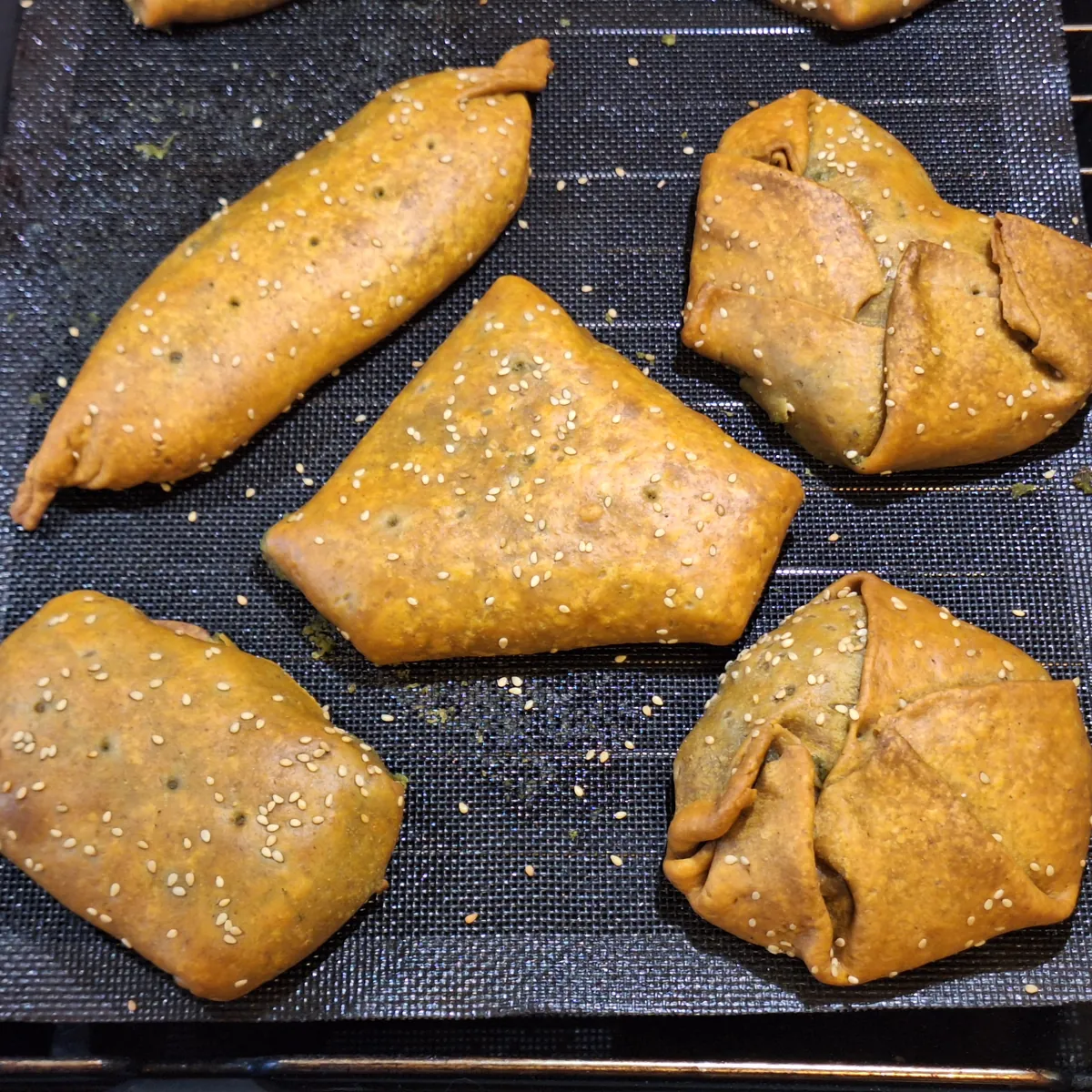
Savoury Parmesan and Spinach Parcels
Set the amount of ingredients you want to use with one of the two options below:
Quantity
Fresh spinach (raw weight) (min g, max g):
g
1. Ingredients
Filling
| Ingredient | Quantity |
|---|---|
| Fresh spinach (raw weight) | 160 g |
| Firm tofu | 125 g |
| Grated parmesan | 75 g |
| Salt | 1 g |
| Nutmeg | to taste |
| Garlic | to taste |
| Extra-virgin olive oil | to taste |
| Pepper | to taste |
Shell
| Ingredient | Quantity |
|---|---|
| Crispy paprika pasta matta | 1 batch |
2. Method
- Get ready (before you start)
- Prepare the crispy paprika pasta matta and let it rest, covered, while you make the filling. For 320 g of spinach you can use 300 g of total pasta matta flour (150 g semolina + 150 g type 2).
- Filling
- Blanch the 160 g fresh spinach (see the note below on the amount of spinach) in water for 1-2 minutes, then drain. Alternatively, chop it into small pieces (do not use whole large leaves), boil for 1 minute in a covered pan with boiling water, then drain the water and sauté for a few minutes in the pan to dry it.
- Squeeze the spinach firmly to drain the water well. This step is important: the water left in the spinach then has to be compensated for with breadcrumbs, and it still risks coming out in the oven, soaking the pastry shell and making it tear. Better to spend time squeezing it well now than to fix it later.
- Blend the squeezed spinach, the 125 g firm tofu crumbled and squeezed, the 75 g grated parmesan, the garlic, a drizzle of olive oil, a grating of nutmeg and the pepper.
- Blend to a thick, smooth cream. Taste and adjust for seasoning and flavour: parmesan already brings plenty of salt and umami, so add the salt only if the taste calls for it, often it is not needed at all.
- If the mixture is still too wet, stir in the breadcrumbs. Better to add them a little at a time and check the consistency.
- Chill the filling while you roll out the dough: a cold, dry filling holds its shape better and seals without making the shell give way.
- Shaping
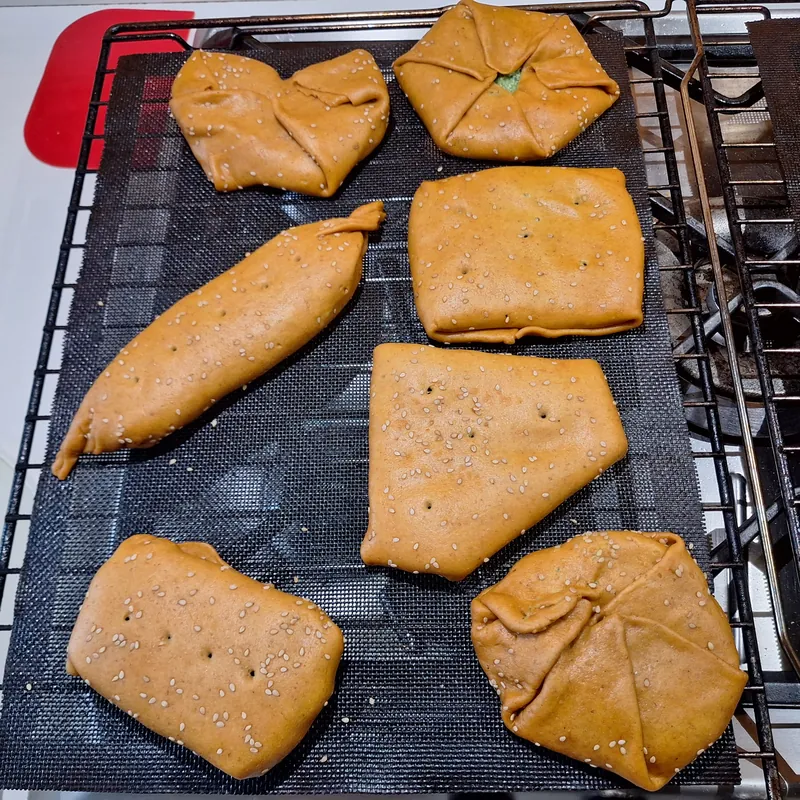
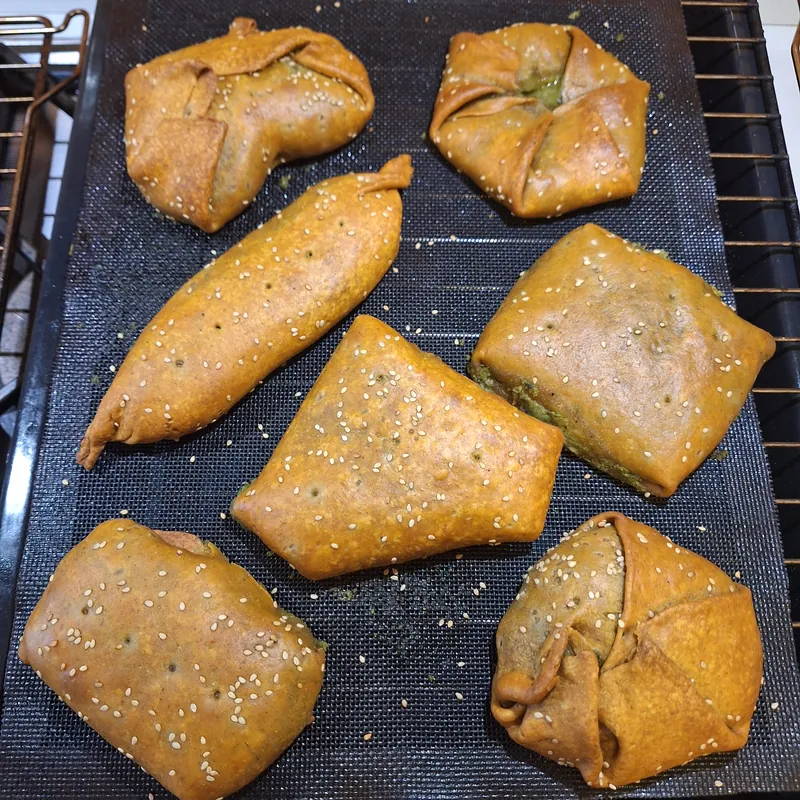
- Divide the pasta matta into balls and roll each into a disc. Place a spoonful of filling in the centre, leaving a generous free border all around. If you like, you can try more creative shapes, as shown in the photos.
- Leave a few small openings, or use a toothpick to make a few holes on the top of the parcel: this lets the filling's steam escape in a controlled way during baking. A fully sealed parcel risks tearing at a random point and letting the filling out.
- Keep the parcel's seam facing up (that is, not resting on the tray): otherwise, if the filling is a little watery, a seam facing down will open during baking and let the filling out onto the tray (learned from experience...).
- Arrange the parcels on a lined baking tray and brush them with a film of olive oil (optional): it gives extra colour and crispness to the surface.
- Baking
- Preheat the oven to 200 °C static and bake for 20-25 minutes, until the pastry is well golden. The filling is already cooked: baking only serves to cook the pastry and firm up the filling by evaporating the residual water.
- Straight out of the oven the filling will be soft: this is normal, it firms up as it cools. Let it cool for a few minutes before serving.
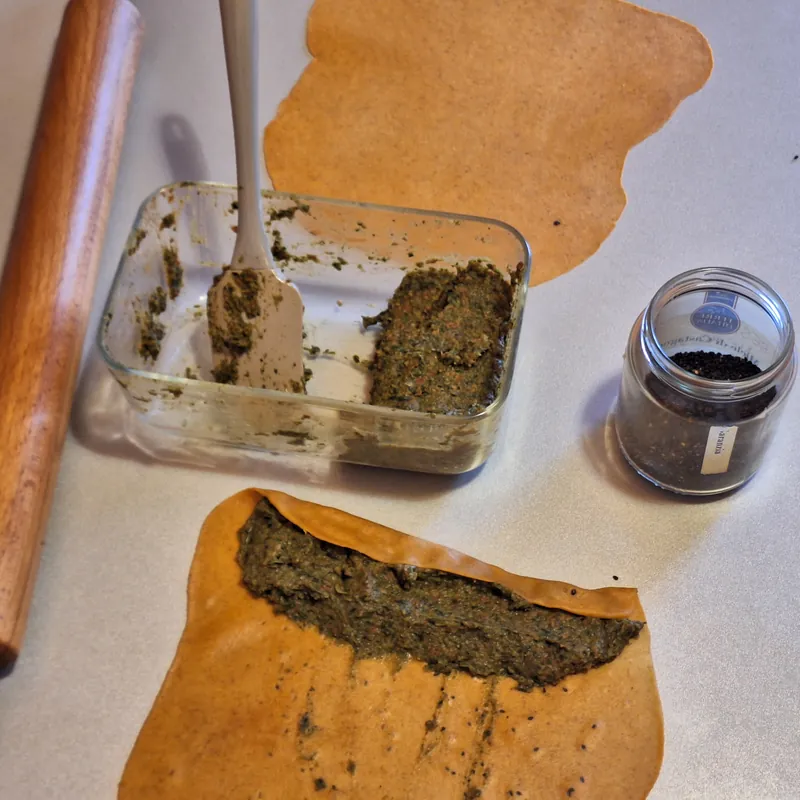
In the photo, the sibling variant: savoury sun-dried tomato and paprika parcels.
3. Storage
Let cool completely before storing.
- Room temperature: for the same day only, in a cool spot. Beyond that, a tofu-and-parmesan filling is a fresh, moist food: at room temperature the risk of bacterial growth rises quickly.
- Refrigerator: 2-3 days in an airtight container. The pastry softens a little; to bring back the crispness, pop them back in the oven at 180 °C for a few minutes.
- Freezer: up to 3 months. You can freeze them cooked (thaw and reheat in the oven) or raw and already shaped (bake from frozen, adding a few minutes). Avoid refreezing after thawing.
4. Technical Notes
- How much spinach to use? The recipe gives a reference amount for the spinach. I have used fresh spinach, frozen, or a mix of the two, and where the recipe said 320 g of spinach I have also used 300, 400, up to 500 g of fresh. The point is that, if it is chopped and blanched first and squeezed well after cooking, the mixture still comes together nicely.
- Can I swap the spinach? Yes, of course. I have used chicory, catalogna chicory, chard leaves and chard: they all work, but the final flavour changes. Chicory brings a bitter background note, while sweet greens like chard leaves and chard stay more on the sweet side. As always, go with what you have in the pantry and your own taste.
- The spinach water is problem number one. Fresh spinach releases far more water when cooked than it seems to hold. Moisture not removed beforehand comes out in the oven and soaks the shell from the inside: it is the main cause of a parcel that tears or stays soggy. Squeezing the spinach until it barely drips is the most effective insurance.
- Why firm tofu (not silken). Firm tofu, well pressed, brings structure and little water; blended with the spinach it gives a creamy base that firms up in the oven thanks to the thermal coagulation of its proteins. Silken tofu is creamier but far wetter, and risks leaving the filling soft.
- Why 150 g of parmesan need just 2 g of salt (or none). Parmesan is naturally very savoury: 150 g already introduce a significant amount of sodium, plus a large hit of umami from the glutamate released during its long ageing. That is why salt should only be added after tasting: the filling is often already well seasoned as is.
- Nutmeg and spinach. It is a classic, proven pairing: the warm, slightly woody note of nutmeg balances the green, mineral flavour of spinach. Use it in a tiny amount, as a background aroma that should not be openly recognisable.
- Raw garlic in the blend. Garlic blended raw is sharper and more persistent than cooked garlic, and in a filling that is not sautéed again that peak remains. Better to start with a little: for a rounder taste, blanch a clove together with the spinach to mellow it.
- The seal and the vents. Leaving one or two small vents lets the filling's steam escape in a controlled way, instead of the shell giving way at a random point: this is a principle recognised in other baked filled pastries too. The real hold depends mostly on three things: a cold, dry filling, air pushed out before sealing, and a wide, well-closed border.
- Baking is for the pastry, not the filling. The filling is already cooked: the 20-25 minutes at 200 °C serve to cook the pastry and evaporate the residual water, firming the filling. Straight from the oven the filling is soft and sets as it cools.
5. Variants
- Legume base instead of tofu: replace the tofu with the same amount (1:1) of cooked, well-drained cannellini, borlotti or chickpeas. The texture stays creamy; the flavour becomes a little more rustic and sweet depending on the legume.
- Lemon zest: a grating of lemon zest in the filling lightens the taste and makes it fresher, a classic addition to spinach-and-cheese fillings.
- Fresh herbs: chopped parsley, dill or mint bring a fresh aromatic note, typical of Mediterranean vegetable fillings.
6. Sources
- Serious Eats: a mix of leafy greens beyond spinach alone for a more complex filling
- Serious Eats: sautéing spinach to evaporate its water instead of adding it
- Serious Eats: nutmeg as the canonical note with spinach and dairy
- Tasting Table: a grain/starch in the filling absorbs moisture and keeps the pastry crisp
- KimEcopak: sodium content of parmesan (about 1500-1800 mg/100 g)
- MyPrepTable: spinach moisture is the number-one enemy of filled pastry
- PastryWiz: cold filling, firm seal and steam vents in filled pastries